I came across these paintings of wounded angels while looking through some online galleries.
They show the figures with broken wings and it gives them a more ordinary look than usual angel art.
I have tried painting wings myself and I know how tricky it can be to make them seem damaged without overdoing it.
A few of these caught my attention because of the simple way the artists handled the light and colors.
I gathered twenty of them here in case you want to see what stood out to me.
Seated Angel with Hand Resting on the Shoulder

A seated angel painting idea focuses on a single figure with large wings shown in a curled posture, one hand placed on the opposite shoulder and the other resting on the leg. The composition works because the wings extend outward on both sides while the body stays compact, creating a balanced shape that fills the canvas without extra props. Loose brushwork and a teal background with warm drips keep the figure as the clear center while letting the wing texture add most of the visual interest.
What makes this idea useful is the self-contained pose that needs no supporting objects or complex setting. The limited color palette of cool background tones against warmer skin and wing colors makes it easy to match different room styles or repeat in smaller studies. You could simplify the wing edges for a quicker version or keep the drips in the background to add movement. For practice, the clear gesture and wing placement give beginners something concrete to aim for while still leaving room to adjust the wing size or dress folds.
Angel Portrait with Tears and a Single Feather

A wounded angel portrait centers on a young figure with feathered wings, visible tears, and a single white feather held in both hands. The idea uses soft watercolor washes in cool grays and muted blues to keep attention on the face and hands rather than background details. This approach fits emotional figurative work where the expression and simple prop carry the whole piece.
The composition does a lot of the work here by keeping the figure close and the background plain, so the idea translates easily to different paper sizes. You can swap the feather for another small object or adjust the wing color without changing the overall feel. For practice, this subject gives clear targets for skin blending and soft edge control in one session. The tight crop also makes it simple to turn into a greeting card or small print.
Child Angel with a Bandaged Wing by the Window

A figure painting idea that places a young angel with one repaired wing on a windowsill works by using the open window as a built-in frame for the background town view. The composition keeps the child as the clear focal point while the vertical color blocks on the left wall and the distant rooftops add just enough setting without crowding the scene. This approach fits a narrative or decorative figure style where the subject stays small-scale and the setting supports rather than competes.
What makes this idea useful is the way the window ledge and wall stripes create natural divisions that make the layout easier to plan. You could simplify the background buildings into loose shapes or change the wall colors to match a room you already have in mind. The patched wing gives a clear focal detail to practice without needing complex anatomy, and the same setup could work as a small canvas piece or a larger wall print. For Pinterest, a contained scene like this tends to read well at thumbnail size because the main shapes stay distinct.
Kneeling Angel with Tattered Wings in Rain

A wounded angel figure kneels low in shallow water with large, frayed wings hanging behind it. The idea centers on a bowed posture and heavy vertical rain lines that push the eye downward toward the water and the figure’s hands covering its face. Cool blues mixed with earthy browns and gold highlights create a stormy setting that keeps the focus on the angel without needing extra props or detail.
What makes this idea useful is how the rain and background do most of the atmospheric work, leaving the figure as the main point of interest. The pose stays simple enough to sketch quickly while still allowing room to adjust wing damage or water level for different versions. For practice, this kind of scene works especially well because the limited palette reduces color mixing decisions and the vertical lines help hold the whole piece together.
Wounded Angel with Bandaged Wings and Lyre
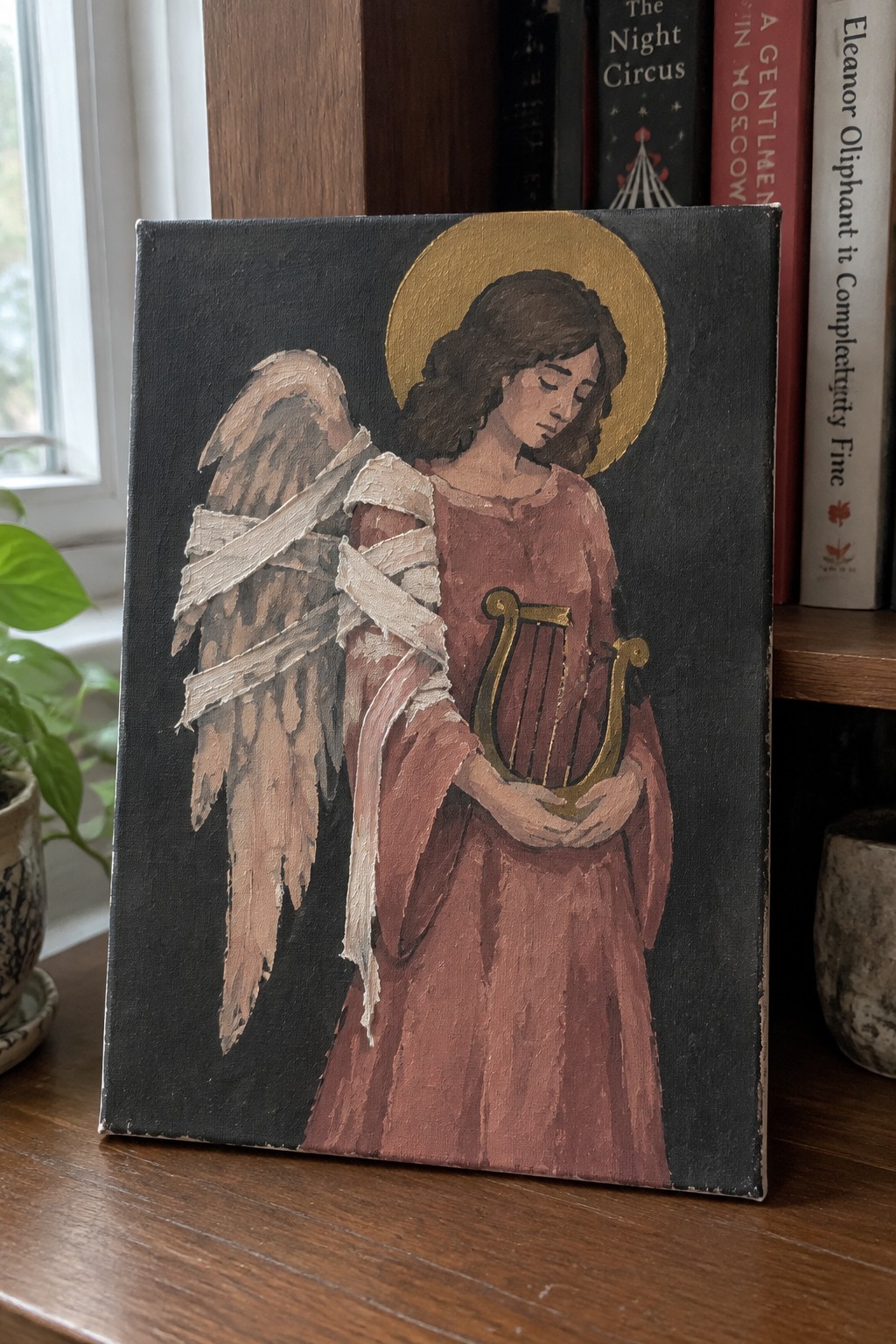
A wounded angel figure stands against a dark background while holding a golden lyre, with both wings wrapped in visible white bandages that show frayed edges and uneven layers. The idea uses a muted palette of reddish-brown for the robe, soft browns for the wings, and gold highlights on the halo and instrument to create contrast without bright colors. This setup keeps the focus on the damaged wings as the main feature while the lyre adds a clear object for the hands to hold.
What makes this idea useful is the straightforward vertical layout that places the wings on one side and the instrument on the other for easy balance. The dark background removes the need to paint scenery, so the work stays centered on the figure and the bandage texture. This approach works well for practicing how to layer paint to show wear and tear on wings. The same idea can be adapted by changing the instrument or simplifying the bandages into fewer strips for a quicker version.
Angel Wings That Scatter Into Birds

The main idea here is a wounded angel whose large wings are actively disintegrating, with feathers detaching and transforming into small birds that fly off toward the upper right. This creates a clear sense of movement and loss through the diagonal composition, where the figure stays grounded on the left while the broken wing elements trail away. The soft watercolor washes and muted blue-gray palette support the theme by keeping attention on the transition from solid wing to scattered birds rather than on sharp details.
What makes this idea useful is the built-in sense of motion created by the wing turning into birds, so the painting feels complete even without extra elements. You could adapt it by reducing the number of birds for a faster study or shifting the palette toward warmer tones if you want a different mood. For practice this works well because the figure can stay simple while the wing and birds provide the main interest. The loose background keeps the focus on the angel and the flying birds, making it easy to try on different paper sizes.
Folk Art Angel with Stitched Broken Wing

A folk art angel painting idea centers on a standing figure with clasped hands, a simple halo, and one wing shown intact while the other appears broken and repaired with visible stitching. The concept uses flat shapes, repeating floral patterns on the robe and wings, and a solid teal background to keep the focus on the figure and the contrast between the two wings. Scattered flowers and dots around the edges balance the composition without overcrowding it.
The composition does a lot of the work here because the solid background lets the patterned dress and mismatched wings carry the visual interest. You can adapt this idea by changing the wing repair style, swapping the teal for another bold color, or simplifying the flowers into fewer shapes for quicker versions. For wall art this works especially well since the flat style and limited palette translate easily to different canvas sizes or even wood panels.
Wounded Angel on a Cliff at Sunset

A wounded angel with broken wings sits hunched on the edge of a rocky cliff, knees pulled close and head bowed. This painting idea pairs a central figure with a simple landscape, using the contrast between the cool blue upper sky and the warm sunset band along the horizon to keep the eye on the damaged wings and the figure’s position. The side placement of the angel leaves room for the open sky and water to do the work of framing without extra elements.
What makes this idea useful is the built-in focal point created by the figure against the gradient sky. The color split between the darker cliff and lighter horizon makes it straightforward to adapt for different canvas sizes or to simplify the rock texture if you want fewer details to handle. A painting like this works especially well for practicing figure proportions with added wings, and the same layout could be reused with minor changes like a different sky color or wing angle to create matching pieces.
Angel Portrait with Cracked Halo and Pinned Wing
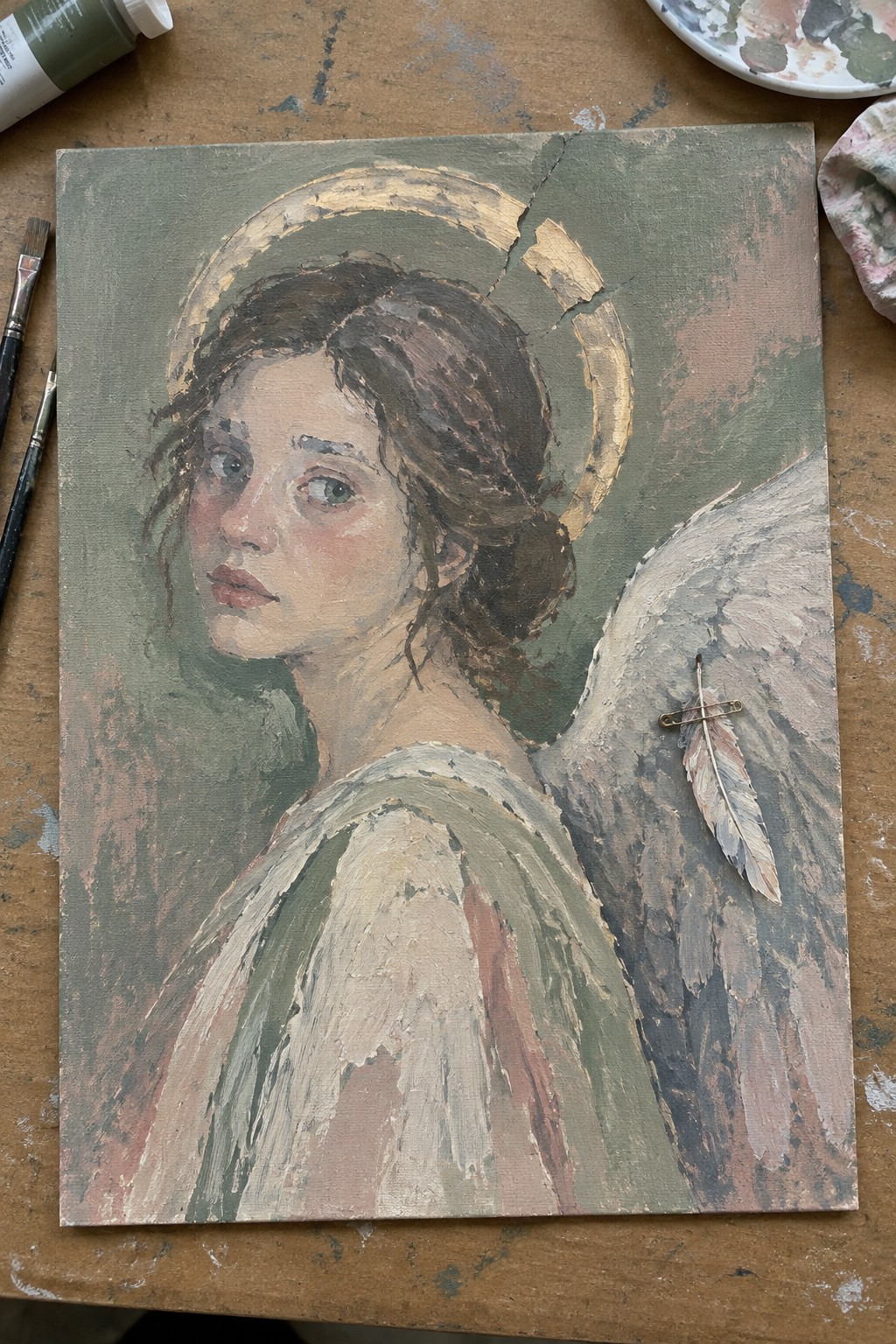
This painting idea centers on a close-up view of an angel figure whose golden halo shows visible cracks and whose wing has been fastened with a safety pin holding a single feather. The composition keeps the face turned slightly away while the wing occupies the right side, using textured layers and a limited palette of greens, browns, and pale skin tones to draw focus to the damaged areas. It works as a figurative piece that fits the wounded angel category through its emphasis on repair details rather than complete wings.
The tight crop around the head and shoulder makes it simple to scale down for smaller canvases or sketchbook practice. You can change the pin to another object or soften the halo cracks to adjust the level of damage without losing the overall structure. The muted background also makes it easy to adapt for different wall colors while keeping the metallic halo as the main point of interest.
Angels Tending to a Broken Wing
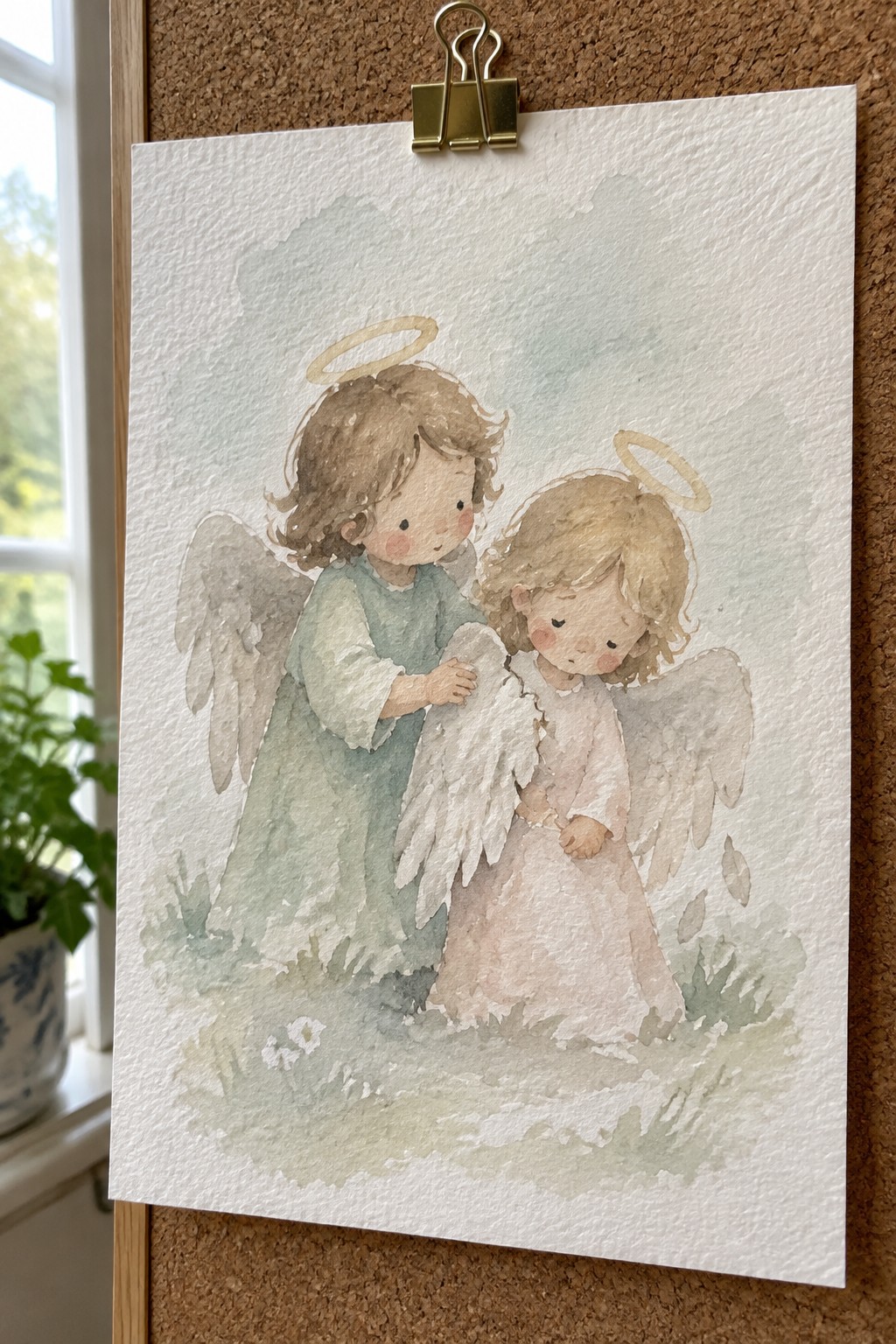
A painting idea that centers on two small angels where one holds and examines the torn feathers of the other’s wing. The figures stand close in a loose grassy patch, with soft overlapping shapes and a muted palette of greens, pinks, and browns keeping the focus on their interaction. This approach works as cute narrative illustration because the simple setting and gentle poses let the damaged wing become the clear center of attention.
What makes this idea useful is the built-in focal point created by the wing gesture, which stays readable even if you simplify the background or change the scale. The color choices are easy to adapt for different moods or seasons without redrawing the figures. For wall pieces or gifts, the compact composition translates well to smaller formats while still showing the main action clearly.
Angel with Damaged Wings Seated on Stone Steps

A painting idea built around a wounded angel resting on outdoor steps, her broken wings shown with uneven feather loss and muted tones while she holds a small bouquet of wildflowers. The figure sits centered against a blue door and textured wall, with the wings positioned to create an asymmetrical shape that stands out against the pale dress. This fits into figurative work where the damaged wings act as the main focal point and the setting stays simple enough to keep attention on the subject.
The composition does a lot of the work here by using the steps and door to frame the figure without extra elements. You could adapt the palette by shifting the door color or changing the flowers to match a different season. For practice, this kind of subject works well because the wing damage gives you clear areas to focus on texture and layering while the rest of the scene stays straightforward. A version of this would stand out on Pinterest in angel or symbolic figure collections because the quiet pose and visible damage read clearly even at small sizes.
Angel Silhouette With a House Inside the Wing

A silhouette angel painting uses a dark navy background to set off a light figure whose wing shape holds a small house and tree scene inside it. The idea centers on replacing part of the wing with a miniature landscape, so the wing itself becomes the frame rather than just a solid shape. Rough edges around the wing and simple color blocking keep the focus on that contrast between the solid figure and the detailed insert.
What makes this idea useful is the way the wing outline does most of the compositional work, letting you drop any small scene into that space without redrawing the whole figure. The high contrast between background and figure makes the painting readable even when scaled down for prints or cards. You could swap the house for other small elements like a window or a tree line and keep the same layout, or simplify the wing edges further if you want a quicker version for practice.
Wounded Angel Resting on Stone Steps
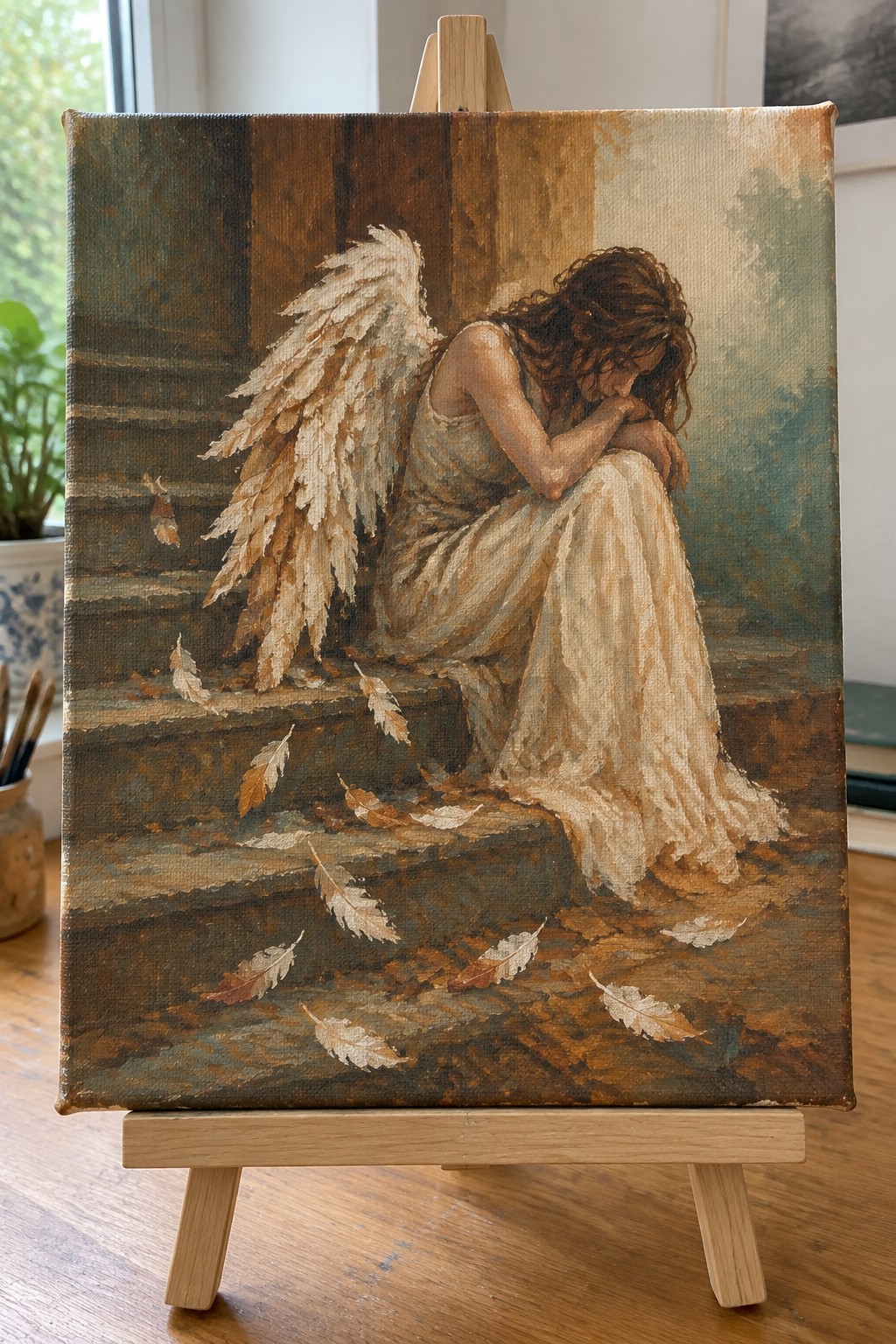
A single angel figure with large damaged wings sits hunched forward on old stone steps, head lowered and arms wrapped around her knees. The idea centers on the contrast between the pale figure and the scattered feathers that trail down the stairs, using a muted brown and green background to keep the focus tight. This fits the category of emotional figurative painting where the composition relies on downward lines and a limited palette to suggest stillness.
What makes this idea useful is the clear focal point created by the wings and the way the steps naturally guide the eye without extra elements. The earthy color scheme works well for practice because it stays simple to mix and can be adjusted to warmer or cooler tones depending on the mood you want. You could easily adapt it to a smaller canvas by cropping to the upper body and one wing, or add a few more feathers if you want to change the level of detail. For wall art, the vertical layout and restrained background help it read clearly from a distance.
Hand and Feather Study With Partial Wing

A strong painting idea here centers on a hand holding a single large feather right beside a section of wing. The composition keeps the focus tight by letting the wing act as a soft vertical frame while the hand and feather fill the center. Loose watercolor washes in muted greens create a simple background that lets the pale hand and feather details come forward without extra elements. This approach fits the wounded angel theme through a small, contained moment rather than a full scene.
The composition does a lot of the work here by using the wing edge to balance the hand without needing a full figure. You can adapt it easily by changing the feather to a different size or shifting the background to cool grays for a quieter version. For practice, the subject gives you a clear way to study hand structure and soft blending in one piece. A painting like this would work well as a standalone print or as part of a series because the partial wing adds context without extra work.
Bowed Angel Portrait With Wing Focus

This painting idea centers on a young winged figure shown in profile with head bowed and one large feathered wing taking up the left side of the frame. The concept works as a close-up character study that pairs the wing structure with draped fabric across the shoulders and back. The loose background strokes in red and teal keep attention on the figure while the visible layering of color and texture adds depth without requiring fine detail everywhere.
What makes this idea useful is the side angle that lets you build the wing first as a clear shape before working on the cloak folds. The color choices stay simple enough to swap out for other combinations if you want a different overall tone. For practice this kind of subject gives you a chance to handle both feather texture and fabric at once in a single session. The scale also works well for a medium-sized canvas or panel without needing a complex setting.
Wounded Angel with a Fallen Feather
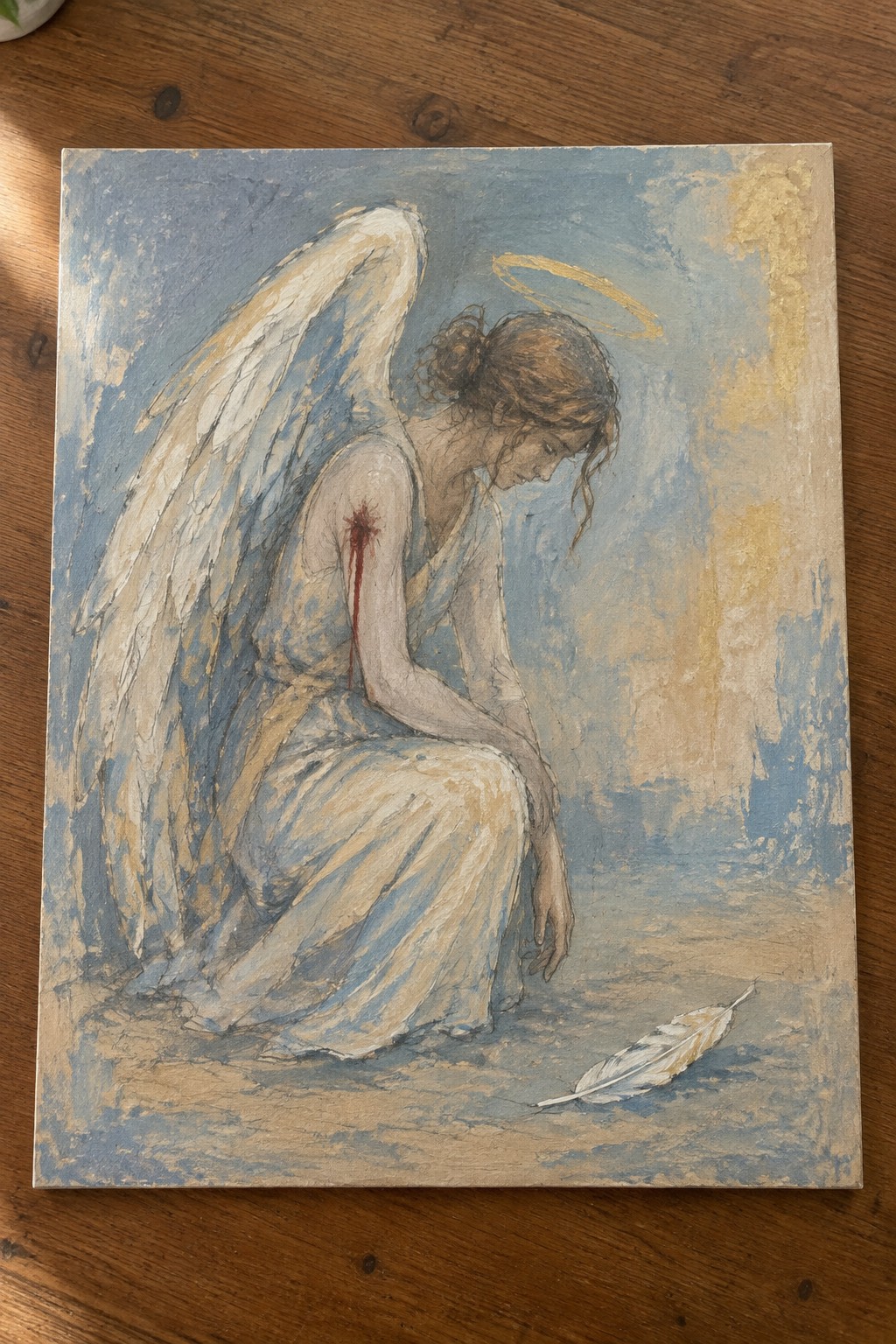
A wounded angel seated on the ground forms the core of this painting idea. The figure is angled slightly away from the viewer with one arm showing a clear red mark and a single feather placed on the floor in front. The composition balances the large wing mass on the left with the open space and small feather on the right, while the soft blue and beige palette keeps the focus on the central figure rather than busy details. This fits the category of figurative painting with a clear narrative element.
What makes this idea useful is the seated pose, which reduces the challenge of drawing full standing proportions and lets you practice wing structure and fabric folds at the same time. The color scheme stays simple enough to mix with a limited palette, and you can easily change the feather size or wound placement to make it your own. For wall art or Pinterest shares, the contrast between the large wings and the single small feather creates a strong focal point without needing extra elements. You could adapt the background to a flat tone or rough texture if you want to finish it faster.
Angel with a Patched Wing in a Stone Arch

A wounded angel figure sits with one wing visibly mended by a sewn fabric patch, positioned inside a crumbling stone arch that frames a simple landscape of hills and a low sun. This is a figurative painting idea that pairs a central character with architectural ruins and soft background layers to create a clear sense of place. The muted earth tones and gentle color shifts between the figure, arch, and distant hills keep the composition balanced and easy to follow.
What makes this idea useful is the strong vertical structure of the arch, which naturally contains the scene and reduces the need for extra background work. The color palette stays limited to soft neutrals and greens, so it adapts well if you want to change the size or swap in different background elements like trees or water. For practice, this kind of subject lets you focus on figure posture and simple texture details like the wing patch without requiring advanced techniques. You could simplify the landscape further or adjust the patch size to make the piece feel more personal.
Angel with One Broken Wing in Soft Watercolor

A standing angel figure with one wing fully formed and the other showing torn, irregular edges creates the core of this painting idea. The contrast between the two wings draws the eye while the loose, blended washes around the figure keep the background simple and supportive. Cool blue and purple tones in the washes help the pale robe and wings stand out without competing details.
What makes this idea useful is how the damaged wing supplies visual interest without extra objects or props. You could scale it down for a greeting card or enlarge the figure to fill more of the paper for a wall piece. The soft edges and overlapping washes are easy to adjust if you want to change the color temperature or try the same layout on a different paper texture.
Angel Raising a Torn Banner

An angel stands in a strong upward pose while lifting a long strip of ragged white cloth marked with red streaks high overhead. The figure is set against a divided background with a dark upper field and a deep red lower section, while the wings extend to the side and gold leaf runs along the outer edges. This creates a clear focal point on the raised arm and the damaged fabric against the contrasting color blocks.
The vertical composition and single strong gesture make the idea easy to adapt to different canvas sizes or even smaller studies. You can simplify the red background to a flat tone or change the cloth color to test different contrast levels without losing the core idea. For wall pieces, the limited palette and bold arm position help the painting read clearly from a distance, and the same setup works well if you want to personalize the fabric details or add more texture to the wings.
Wounded Angel Leaning Against a Tree
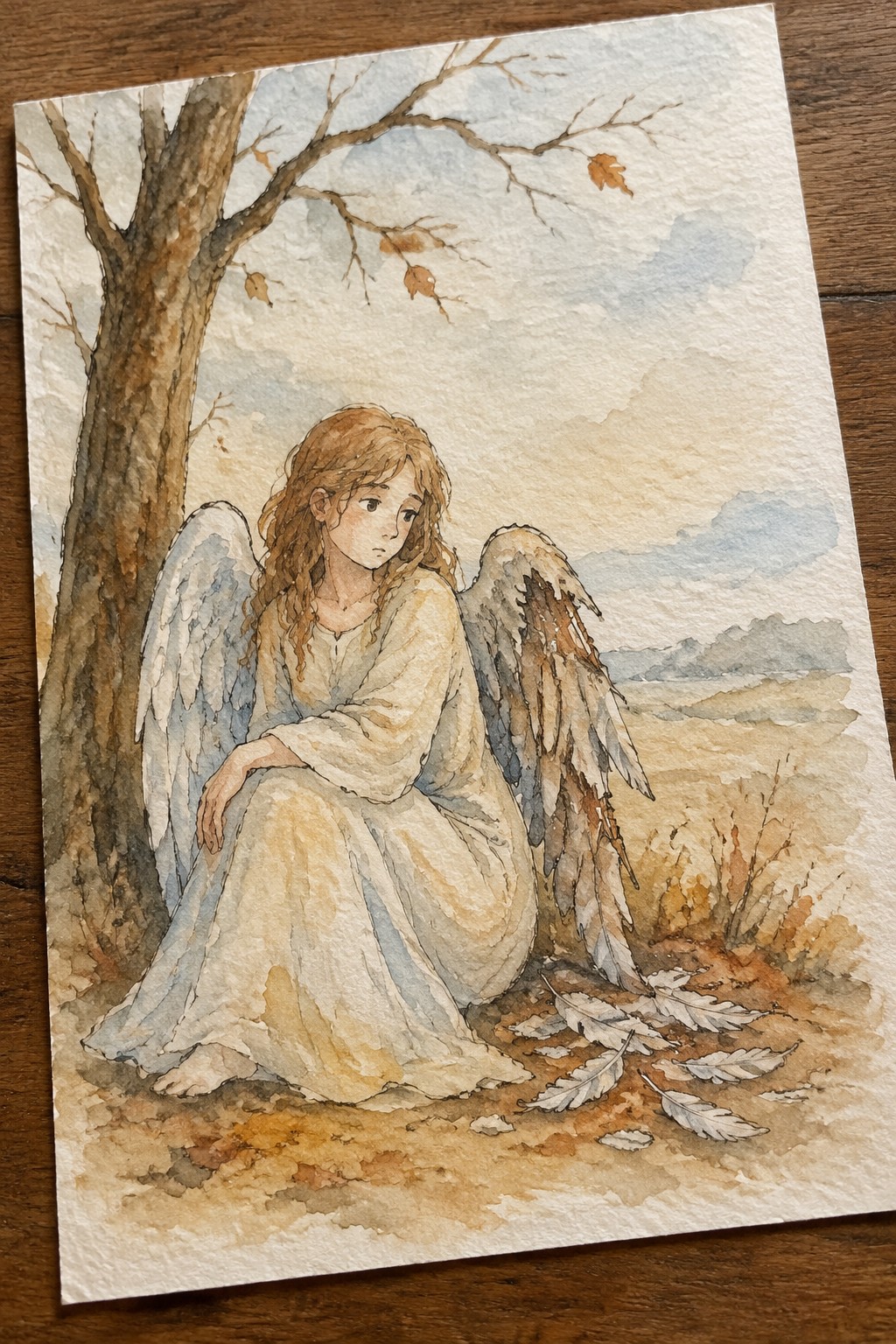
A seated angel with large wings rests on the ground beside a tree, one wing clearly missing feathers and showing wear. This painting idea centers on a figure in a landscape setting, using the tree trunk to frame one side while an open field stretches across the other. Soft color washes and a limited palette of browns, creams, and pale blues keep the focus on the angel’s posture and the contrast between the intact and damaged wings.
What makes this idea useful is how the tree acts as a built-in vertical element that supports the figure without extra props. The loose background and scattered leaves let you adjust the season or simplify the setting easily. For practice, this kind of subject combines figure work, fabric folds, and wing details in one balanced scene that still reads clearly even at smaller sizes.
Frequently Asked Questions
What do the broken wings symbolize in these angel paintings? Broken wings typically represent emotional vulnerability, lost innocence, or the weight of personal struggles. Viewers often connect with them as metaphors for healing and inner strength, encouraging reflection on their own experiences with pain and recovery.
How were the 20 paintings chosen for this collection? The selection focuses on works that capture deep emotional resonance through expressive poses, muted color palettes, and symbolic details. Curators prioritize pieces from various eras that highlight themes of fragility and hope to create a balanced and moving overview.
Where can I find prints or view the original paintings? Many of these artworks appear in public galleries or online museum archives. High-quality prints are available through reputable art sites or artist estates, allowing you to bring the pieces into your space for personal inspiration.
How do these paintings help people process emotions? By depicting angels in states of injury yet still graceful, the images offer a visual language for grief, resilience, and compassion. Readers often report that spending time with them fosters self-compassion and opens conversations about mental health.
Are there common artistic techniques used across the 20 works? Artists frequently employ soft lighting, layered textures, and contrasting elements like feathers against dark backgrounds. These methods draw attention to the contrast between divine beauty and human-like suffering, enhancing the emotional impact.