I have always liked looking at old religious paintings and the way they use gold to highlight certain parts.
Recently I found some Byzantine inspired nativity scenes that feature those classic gold halos around the figures.
They have a simple and elegant style that stands out to me.
I sometimes try to incorporate similar elements in my own small paintings at home.
These pieces feel timeless and I thought it would be nice to share a few examples here.
Byzantine Madonna and Child Icon with Gold Halos

A painting idea built around the Madonna and Child places both figures in a flat, centered composition with oversized gold halos that draw the eye immediately. The color scheme relies on strong blocks of blue and red for the robes, accented by gold trim and a matching blue background scattered with small gold shapes. This setup works as decorative religious art because the bold shapes and limited palette create clear visual weight without needing depth or shading.
What makes this idea useful is how the simple figure placement leaves room to adjust the size of the halos or swap the background pattern for different results. The color choices stay consistent enough to match existing decor while still standing out on a wall. For practice, the subject gives a clear structure to follow so beginners can focus on brush control and even gold application rather than inventing poses. The same layout can be simplified further by reducing the gold dots or scaled up for larger canvases.
Three-Panel Nativity with Solid Color Blocks

A triptych Nativity idea divides the scene into three vertical panels, each with its own background color, placing Mary on the left, the swaddled infant in a manger at center, and Joseph on the right. The gold halos act as the main unifying element across the panels while the flat color fields keep the layout clean and balanced. This approach fits the decorative religious painting category and works especially well when the goal is a clear, readable composition rather than detailed scenery.
The composition does a lot of the work here because the panel divisions naturally guide the eye without needing extra background elements. A painting like this adapts easily to different formats such as a single canvas, three separate boards, or even a folded card. The limited color palette and simple shapes make it straightforward to try in acrylic or gouache, and the idea can be adjusted by swapping the background colors or changing the halo size to fit a smaller or larger surface. For holiday wall pieces this layout stands out on Pinterest because the strong vertical structure reads clearly even at thumbnail size.
Gentle Watercolor Nativity with Golden Halos and Central Star
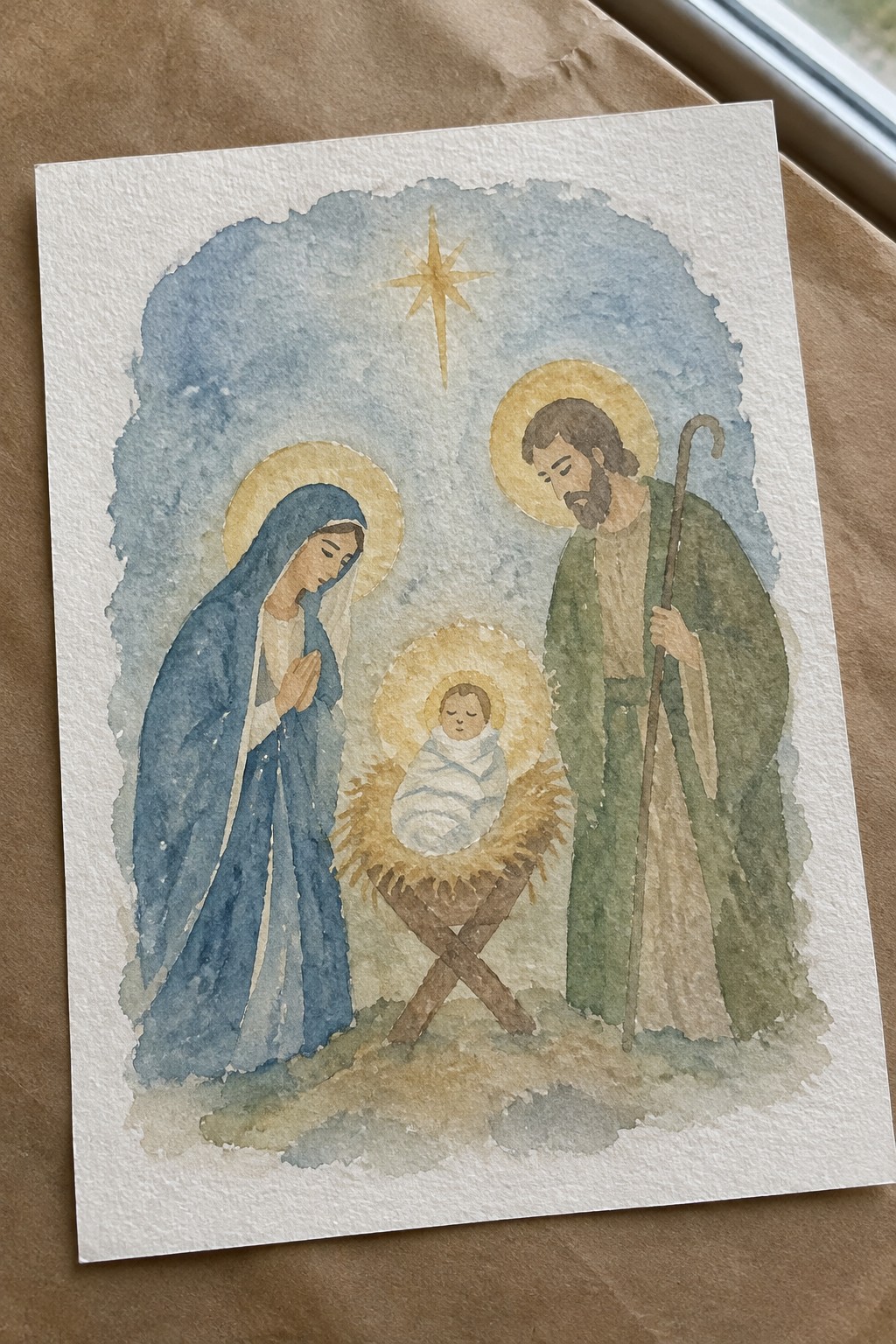
A nativity scene built around a simple triangular arrangement works well here, with the manger placed low in the center and the two adult figures flanking it at equal height. The soft blue background wash creates a contained space without hard edges, while the star sits high enough to balance the lower grouping. This approach fits seasonal decorative art, where the main shapes stay readable even when the paint is applied in loose layers.
What makes this idea useful is how the limited palette and rounded forms reduce the need for precise line work. You could adapt it for greeting cards by shrinking the figures and keeping the star as the only bright accent, or expand the background wash for a larger piece. The halos give an easy way to draw attention to the main subjects without adding extra detail. For practice, this kind of layout helps beginners focus on value and placement before worrying about facial features.
Angel Hovering Over the Stable Nativity

A strong vertical layout places a large winged angel as the main focal point above a compact stable scene. The angel’s outstretched wings and extended arm create a clear downward flow that connects the upper figure to the manger below. Gold halos around the angel, Mary, Joseph, and infant pull the composition together while the teal background and warm wing colors keep the eye moving between the two sections. This approach fits the category of decorative seasonal art with a Byzantine-inspired structure.
The composition does a lot of the work here by separating the angel from the stable with a simple horizontal line, which makes it easy to plan the proportions before adding details. You could scale the whole idea down for a greeting card or swap the wing colors for whatever paints you already have on hand. For practice, this kind of subject lets you work on layering without needing perfect realism since the gold halos and basic animal shapes stay readable even in a loose style. A painting like this would stand out on Pinterest because the bold top-to-bottom arrangement reads clearly even in a small thumbnail.
Byzantine Nativity with Figures Approaching the Stable

This painting idea shows a Nativity arranged as a procession, with several robed figures moving across a sloped ground toward a wooden stable on the right. The star sits high in the blue sky directly above the stable, and gold halos mark the central figures. Flat color areas, simple building shapes in the distance, and strong outlines keep the focus on the arrival rather than on fine detail or depth.
The composition does a lot of the work here by using the slope and the line of figures to guide the eye to the manger without extra perspective work. A painting like this works especially well for seasonal wall pieces or small canvas sets because the gold halos and limited palette stay readable even at smaller sizes. You could reduce the number of figures or swap the background buildings for a plain hill if you want a quicker version for cards or practice.
Byzantine Christ Child Icon with Dotted Halo and Floral Robe Trim

This painting idea shows a centered frontal portrait of a young sacred figure in white and blue robes, accented with repeating gold floral bands along the neckline and front. The composition relies on a large dotted gold halo to frame the head and a raised hand gesture to create balance and focus. It belongs to the category of decorative religious icon art, where limited colors and repeated motifs keep the eye on the figure rather than background details.
The composition does a lot of the work here by using the halo and robe trim to guide attention without needing complex scenery. A painting like this works especially well for Nativity collections or small wall pieces because the flat shapes and gold accents translate easily to different paper sizes or even card formats. You could simplify the floral pattern to basic dots or swap the blue for another color while keeping the same layout and gold halo.
Watercolor Nativity with Gold Halos and Central Star

A nativity painting idea built around a simple stable under a large star uses symmetry and a clear triangle shape to keep the focus on the manger. The composition places the main figures and animals on either side in balanced positions, while soft blue and earth-tone washes set a calm background that lets the gold halos and star stand out. This approach fits the seasonal decorative category and works because the gold accents add contrast without needing complex details.
What makes this idea useful is how the stable roof and star do most of the visual work, so you can finish the piece without filling every area. The layout adapts easily to smaller paper sizes or greeting card formats by dropping the distant town and keeping just the main elements. For practice or holiday wall pieces, the limited palette and repeated gold shapes make it straightforward to try in different sizes while still reading as a complete scene.
Byzantine Nativity with the Three Kings

A traditional Nativity scene works well as a painting idea when the figures are arranged around a central manger with the infant as the clear focal point. The three kings on the right side create a natural flow toward the holy family while the animals on the left balance the composition. Gold halos and a prominent star against the dark blue sky give the piece its Byzantine character and help the main subjects stand out without needing complex shading.
What makes this idea useful is the straightforward grouping of figures that still leaves room to adjust scale or crop for different canvas sizes. The limited color palette of reds, blues, and golds makes it easy to simplify by using fewer figures or flatter color blocks if you want a quicker version. For seasonal wall pieces or greeting cards, the strong outlines and repeated gold accents carry over nicely when the same layout is reduced or turned into a print.
Nativity Icon with Interlocking Gold Halos

A Nativity painting idea built around the holy family grouped inside overlapping gold halos on a deep blue background scattered with small stars. The composition uses curved halo shapes and repeated gold accents on clothing and borders to hold the eye on the central figures while keeping everything else flat and simple. This approach belongs to decorative religious art that borrows from icon traditions through limited color and clear shapes rather than realistic detail.
What makes this idea useful is how the halos do most of the work in creating a balanced layout that works at different sizes. The navy and gold palette stays easy to adapt whether you paint on wood, canvas, or even a smaller panel for a gift. You could drop some of the border patterns or change the star placement without losing the overall structure, which makes it a practical choice for seasonal wall pieces or quick practice pieces.
Watercolor Nativity with Gold Halos and Central Circle
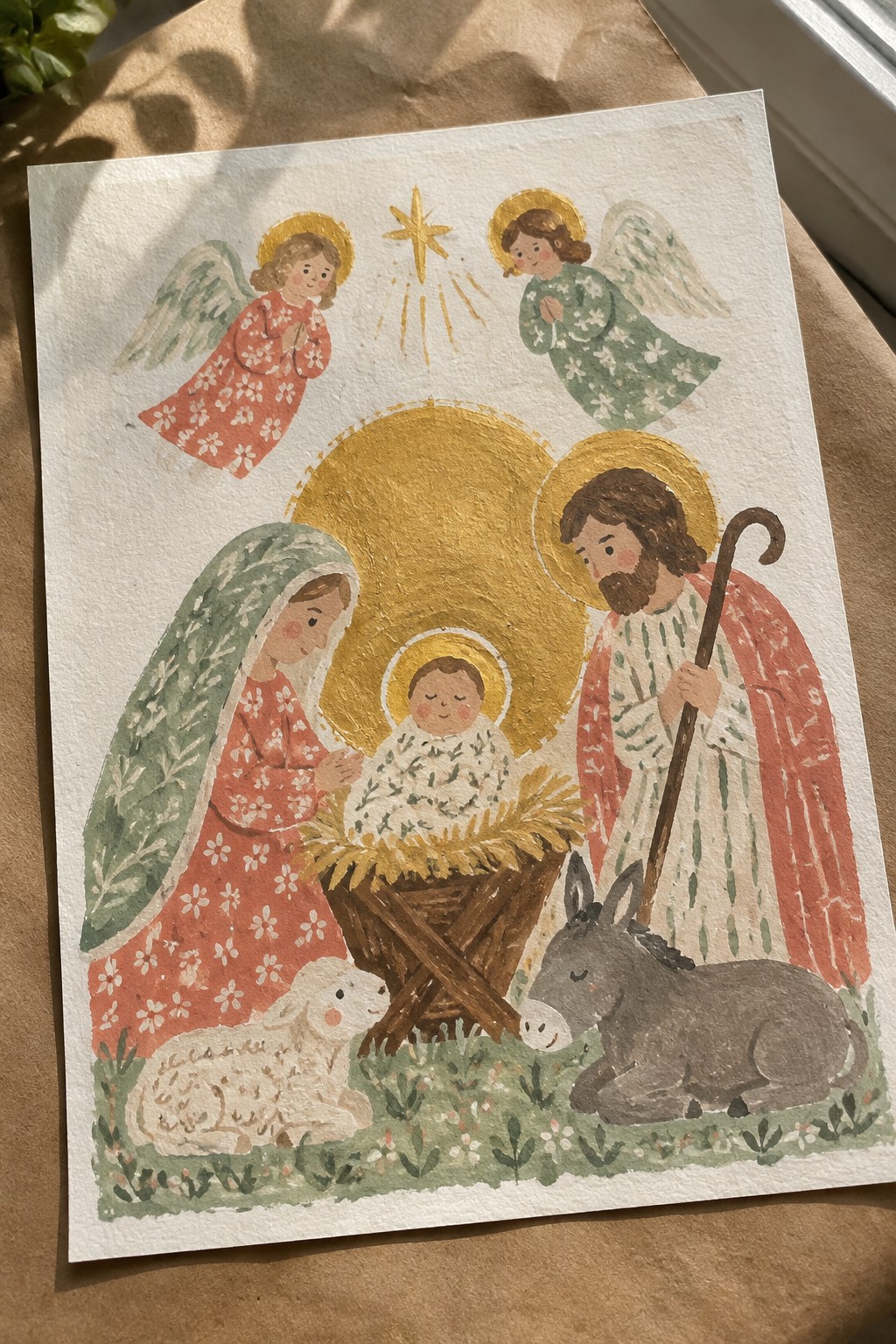
This painting idea uses a compact nativity layout with the holy family positioned around a manger, flanked by angels above and animals below. The composition relies on a large gold circle behind the central figures to create focus while the smaller gold halos on each character tie the scene together visually. Soft washes and repeating floral patterns on the clothing add texture without complicating the overall arrangement, placing it in the category of seasonal decorative art.
What makes this idea useful is the clear separation between the gold elements and the rest of the painting, so the halos and circle can be added last with minimal risk of bleeding. The rounded shapes and balanced grouping make it straightforward to resize for greeting cards or shrink for a sketchbook page. Replacing the donkey and sheep with simple grass or extra angels would reduce the amount of detail while keeping the same structure intact.
Soft Watercolor Nativity with a Single Golden Halo

A nativity scene built around a central manger works well when kept minimal and centered, using soft watercolor washes in earthy browns and muted blues to hold the composition together. The single gold halo draws the eye without competing with the figures, and the open space around the group keeps the layout balanced and easy to read from a distance. This fits the seasonal decorative category because the loose shapes and limited palette let the idea read clearly even at small sizes.
What makes this idea useful is how the simple arrangement leaves room to adjust the scale for cards, prints, or larger pieces without changing the core layout. The muted background makes the gold halo the main focal point, so you can swap in different earth tones or cool blues depending on the season or frame color. For practice, the basic forms let you focus on wash control and placement rather than intricate details, and the same setup translates easily to acrylic or gouache if you want more opacity.
Tiled Mosaic Nativity with Gold Halos

This painting idea centers on a nativity scene where a grid of blue, green, and gold tiles forms the background, setting off the holy family grouped around a manger. The composition places the large golden halos as the main focal points while the star sits above and the animals rest below, creating a balanced vertical layout. The flat shapes and limited color range keep the style decorative and structured rather than realistic.
What makes this idea useful is the clear separation between background pattern and main figures, so the eye stays on the halos and central group. The tile grid can be simplified to fewer rows or changed to other colors without losing the overall effect. For holiday wall pieces or greeting card designs, the same layout works at different sizes and can be painted on canvas or wood panels. The animals and star can be adjusted or left out if a tighter focus on the family is preferred.
Haloed Shepherds Standing with a Lamb
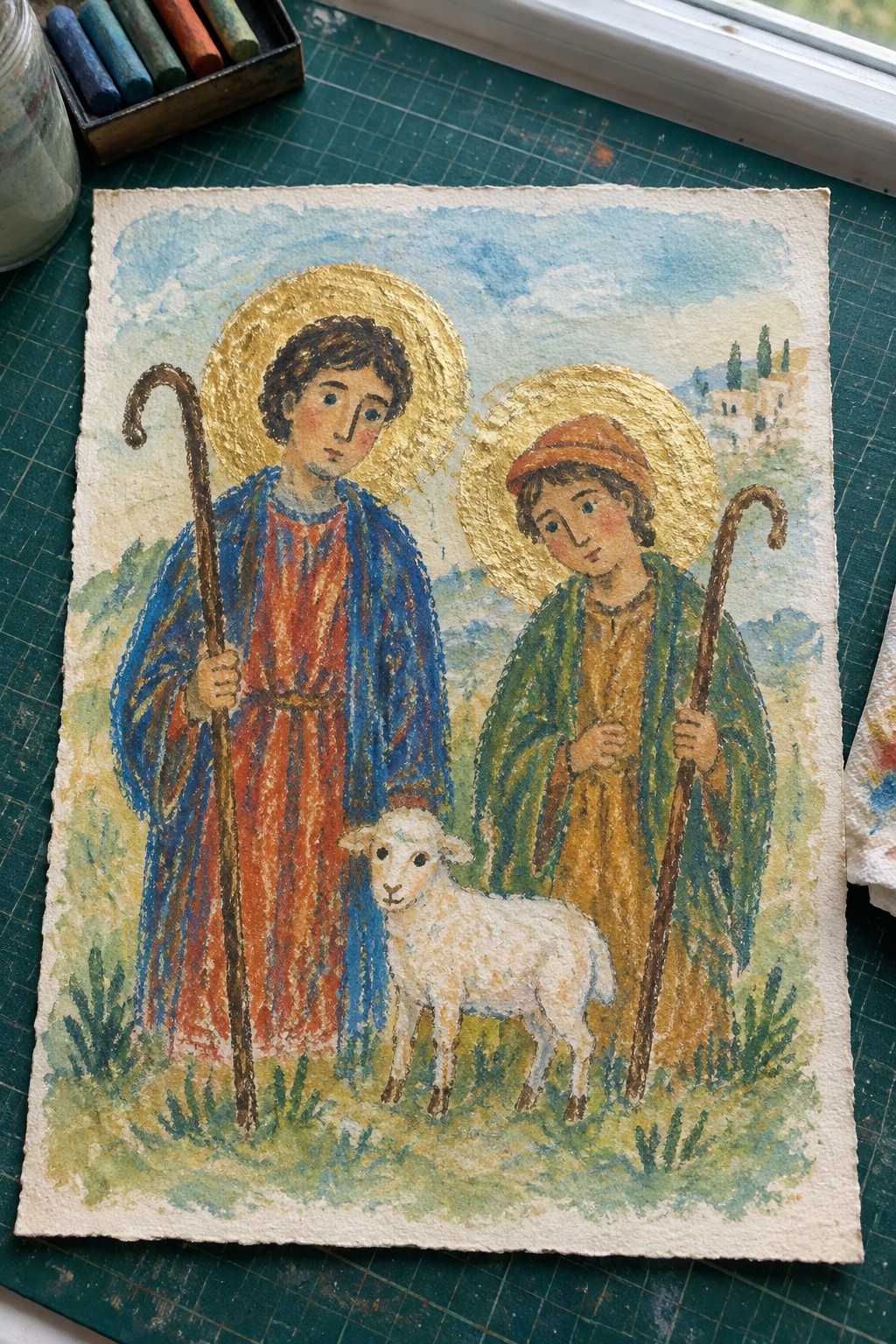
A painting idea built around two young figures with gold halos and a white lamb between them works as a focused Nativity element. The shepherds hold simple staffs and wear layered robes in blue, red, green, and ochre, while the lamb stands centered in the lower half of the frame. A soft landscape with a distant village keeps the background quiet so the three main subjects remain the clear focal point.
The even spacing between the two figures makes the layout easy to scale down for a greeting card or stretch across a larger panel without losing balance. You could swap the landscape for a plain sky or keep the village as a small detail depending on how much background you want to handle. This setup also lends itself to quick color studies since the gold halos provide a strong contrast against most robe combinations.
Holy Family in a Patterned Arched Frame

This painting idea centers on the Holy Family arranged in a classic triangular grouping, with Joseph on the left holding a staff, Mary supporting the child, and the infant Jesus centered with one hand raised. The composition uses a large arched border filled with repeating floral and leaf motifs to frame the figures, while the three gold halos create focal points that keep the eye moving between the family members. The limited palette of deep reds, teal, and gold against a pale background makes the shapes read clearly even from a distance.
What makes this idea useful is how the border does most of the decorative work, so the figures themselves can stay relatively simple. The same layout works at different scales, whether on a large canvas for a mantel or a smaller panel for a gift. The repeating side patterns can be painted freehand or traced from a stencil, and the gold halos are easy to adjust in size or thickness depending on the canvas shape. For seasonal decor, this approach gives a complete finished look without requiring detailed backgrounds or complex lighting.
Close-Up Child Portrait with Dominant Gold Halo

A frontal portrait of a young child acts as the core idea, treated as a sacred figure through a large circular gold halo that frames the entire head. The composition places the face dead center so the halo becomes the main structural element, with radiating lines and a cracked gold texture adding visual weight without extra details. This approach fits the decorative religious portrait category, where the gold circle does most of the work to signal the subject’s importance.
What makes this idea useful is how the halo shape gives an instant focal point that beginners can lay in first before adding the face. The limited palette of warm gold, pale skin tones, and soft blue-green eyes keeps color mixing simple and repeatable. For Nativity-themed wall pieces or small devotional cards, the tight crop works well because it avoids background decisions entirely. The same layout can be scaled down for cards or adapted with different hair colors while keeping the halo as the constant anchor.
Gentle Watercolor Nativity with Haloed Animals
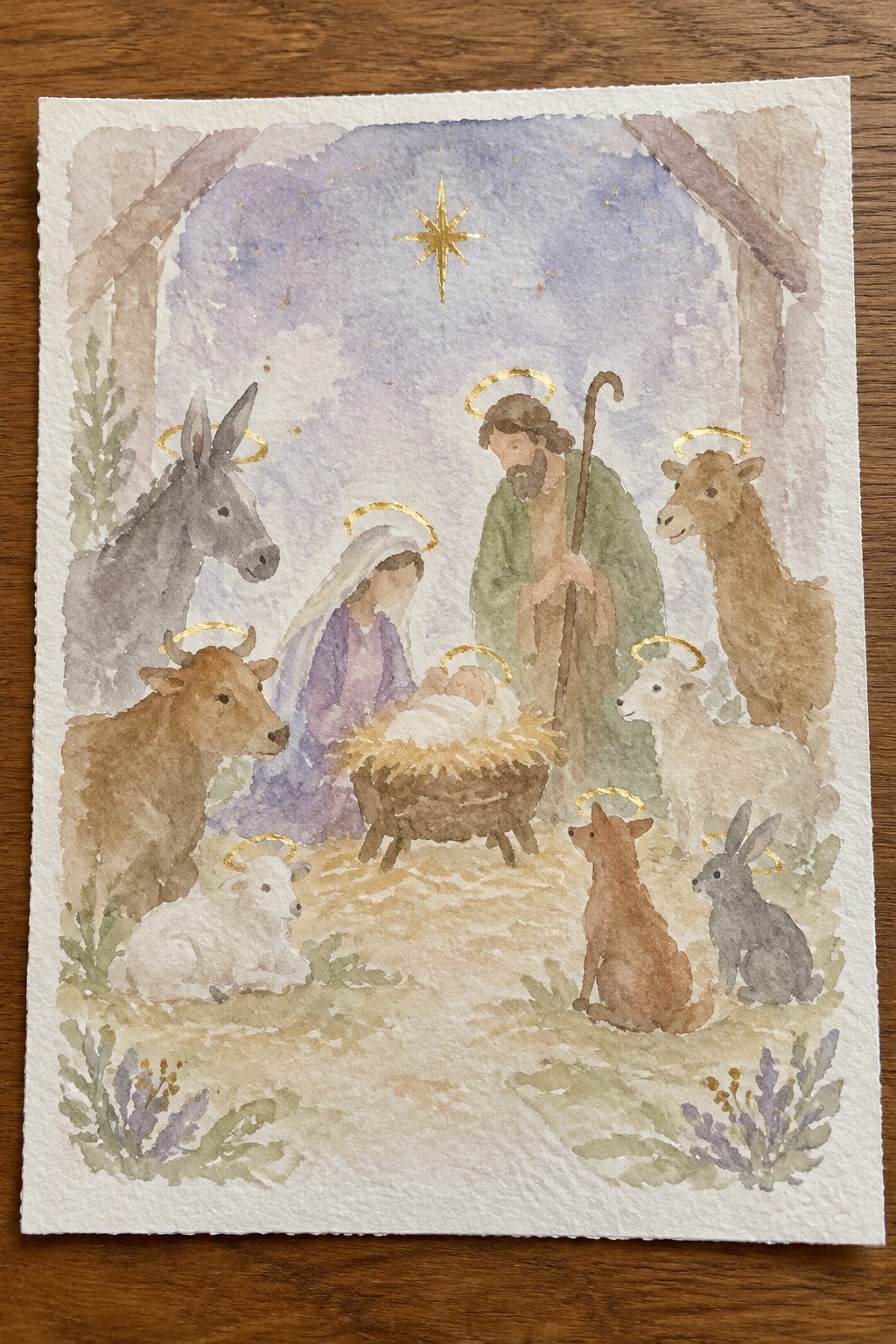
A nativity painting idea built around a central manger scene where every animal also wears a gold halo creates a unified ring of figures that draws attention inward. The soft watercolor washes and loose animal shapes keep the composition from feeling crowded even with seven animals placed around the edges. This fits the seasonal decorative category and works because the gold halos stand out against the muted browns and greens without needing sharp detail.
What makes this idea useful is how the circular arrangement lets you add or remove animals without breaking the balance. The simple color palette of earth tones plus gold makes it easy to adapt for cards, small canvases, or larger wall pieces by scaling the outer figures down. For practice you can start with fewer animals and still keep the halo motif that gives the whole scene its focus.
Byzantine Nativity with Central Manger and Gold Halos

A Nativity painting idea built around a central manger works by arranging Mary and Joseph on either side with the animals positioned just behind to create a compact, readable grouping. The flat shapes, strong outlines, and repeated gold circles for halos give the composition clear focal points against the deep blue background. This category of seasonal decorative art relies on balanced placement and limited detail to keep the main figures easy to distinguish even on a smaller panel.
What makes this idea useful is the way the manger and star fix the layout, so you can add or remove animals without losing the structure. The gold halos and dark background translate well to different sizes, whether you want a wall piece or a smaller gift panel. You could simplify the robe patterns or change the wood tone underneath to fit your own supplies. The bold color contrast and traditional subject make it easy to adapt for Christmas decor without needing advanced figure drawing.
Patchwork Nativity with Gold Halos and Star

A Nativity idea built around three figures arranged in a tight group, each wearing garments made from different repeating patterns that create a layered, assembled look. The deep blue background holds a single large gold star and matching halos that draw attention to the central manger without adding extra elements. This style works well as decorative seasonal art because the simple shapes and repeated patterns keep the composition balanced and easy to read from a distance.
What makes this idea useful is how the patchwork approach lets you reuse scraps of patterned paper or fabric for the clothing while keeping the faces and halos simple. The vertical layout with the star on the left side gives you a clear focal point that works at both small card size and larger wall scale. You could swap in different color families for the patterns or reduce the number of fabric pieces to make it faster for practice pieces.
Nativity Scene with Gold Halos and Central Star

A centered nativity composition places Mary and Joseph on either side of the manger with the infant between them and a large star overhead. Gold halos frame the main figures while smaller gold accents highlight the manger and foliage borders. The idea works as seasonal decorative art because the balanced layout and limited color palette keep the focus on the figures without crowding the space.
The composition does a lot of the work here by using the star and halos as natural focal points that guide the eye downward. You can adapt this for smaller panels or cards by keeping the foliage simple or swapping the greens for other seasonal tones. The gold details make it easy to practice metallic paint or leaf application on a familiar subject. For wall pieces this approach stays readable even at smaller sizes because the shapes stay bold and the background stays plain.
Frequently Asked Questions
What defines Byzantine-inspired Nativity paintings in this collection? These works draw from the Eastern Orthodox tradition with elements like flat perspectives, elongated figures, and rich symbolic details rather than realistic depth. Artists often incorporate gold backgrounds to evoke a heavenly realm while depicting the birth of Christ with figures such as the Virgin Mary, Joseph, shepherds, and angels arranged in a structured composition that emphasizes spiritual meaning over naturalism.
Why do gold halos appear so prominently in these sacred images? Gold halos represent divine light and holiness surrounding sacred figures like the Christ child and the Virgin Mary. This choice stems from Byzantine conventions where the precious metal signifies the uncreated light of God and helps viewers focus on the spiritual essence of the Nativity story instead of earthly details.
How do these 19 paintings differ from typical Western Nativity scenes? Byzantine-inspired versions tend to use more stylized and iconic forms with less emphasis on everyday realism or dramatic lighting. They often include specific symbolic motifs such as the cave setting or the star guiding the Magi and maintain a sense of timeless reverence that connects directly to early Christian liturgical traditions.
Where can viewers find or study the original artworks featured in this group? Many reside in major museum collections across Europe and the United States or in historic monasteries and churches in regions with strong Byzantine heritage such as Greece and Italy. High-resolution digital archives from institutions like the Metropolitan Museum of Art or the British Museum offer close-up views along with scholarly notes on their creation and restoration.
What historical period influenced the creation of these Nativity paintings? The style traces back to the Byzantine Empire from the 4th to 15th centuries when religious icons served as teaching tools for the faithful. Later artists revived these approaches during the Renaissance and into modern times to honor the sacred narrative while preserving the gold halo tradition as a link to ancient devotional practices.