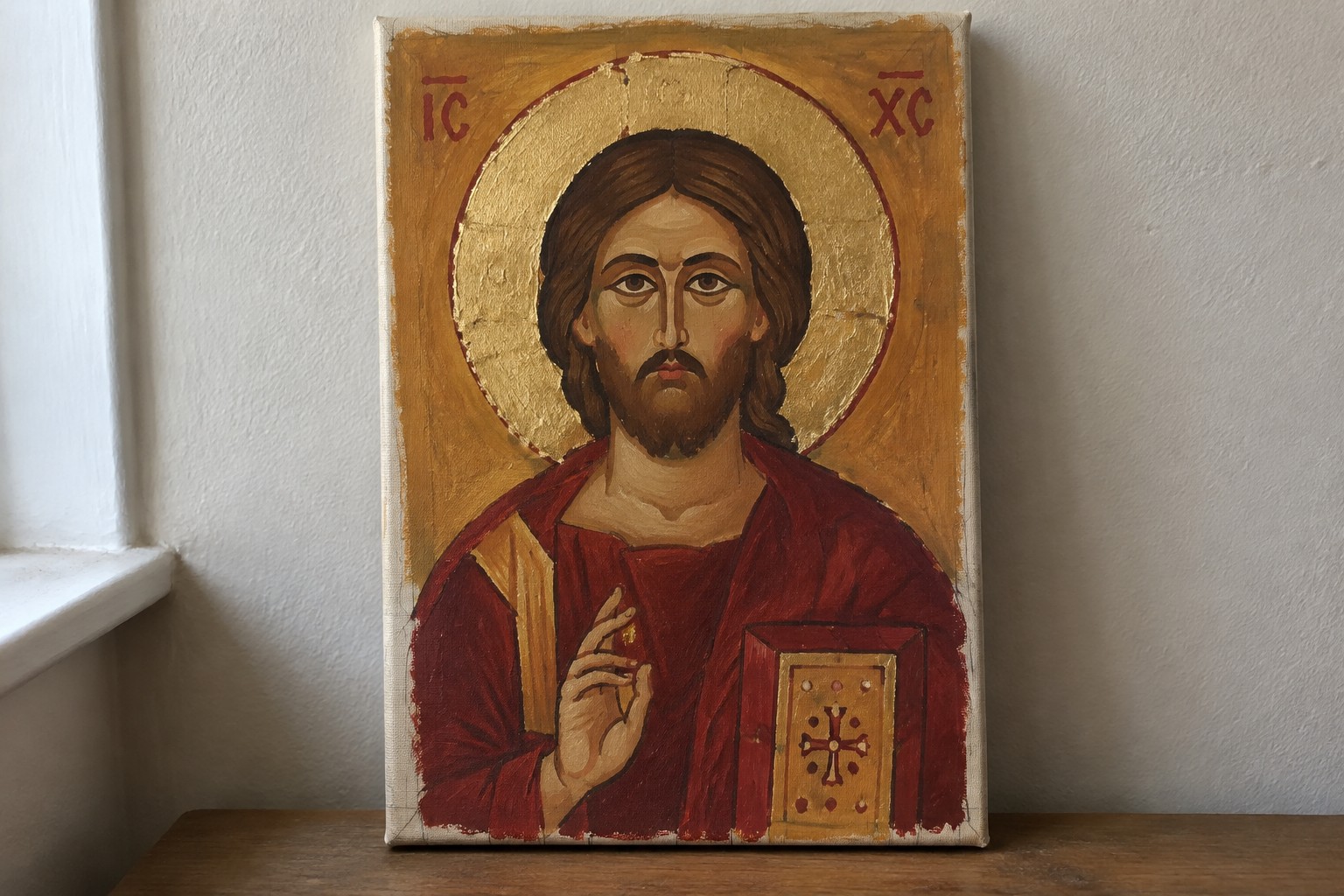
I have been looking at Byzantine inspired paintings for a few months now as part of my own practice with religious subjects.
These works often show the risen Christ in a quiet and direct way that feels different from other Easter art I have seen.
I chose 19 examples that stood out for their style and detail.
They remind me to keep my own brushwork simple and steady when I paint similar scenes.
Some of the colors and poses have already found their way into sketches I am working on at home.
Byzantine Christ Icon with Gospel Book
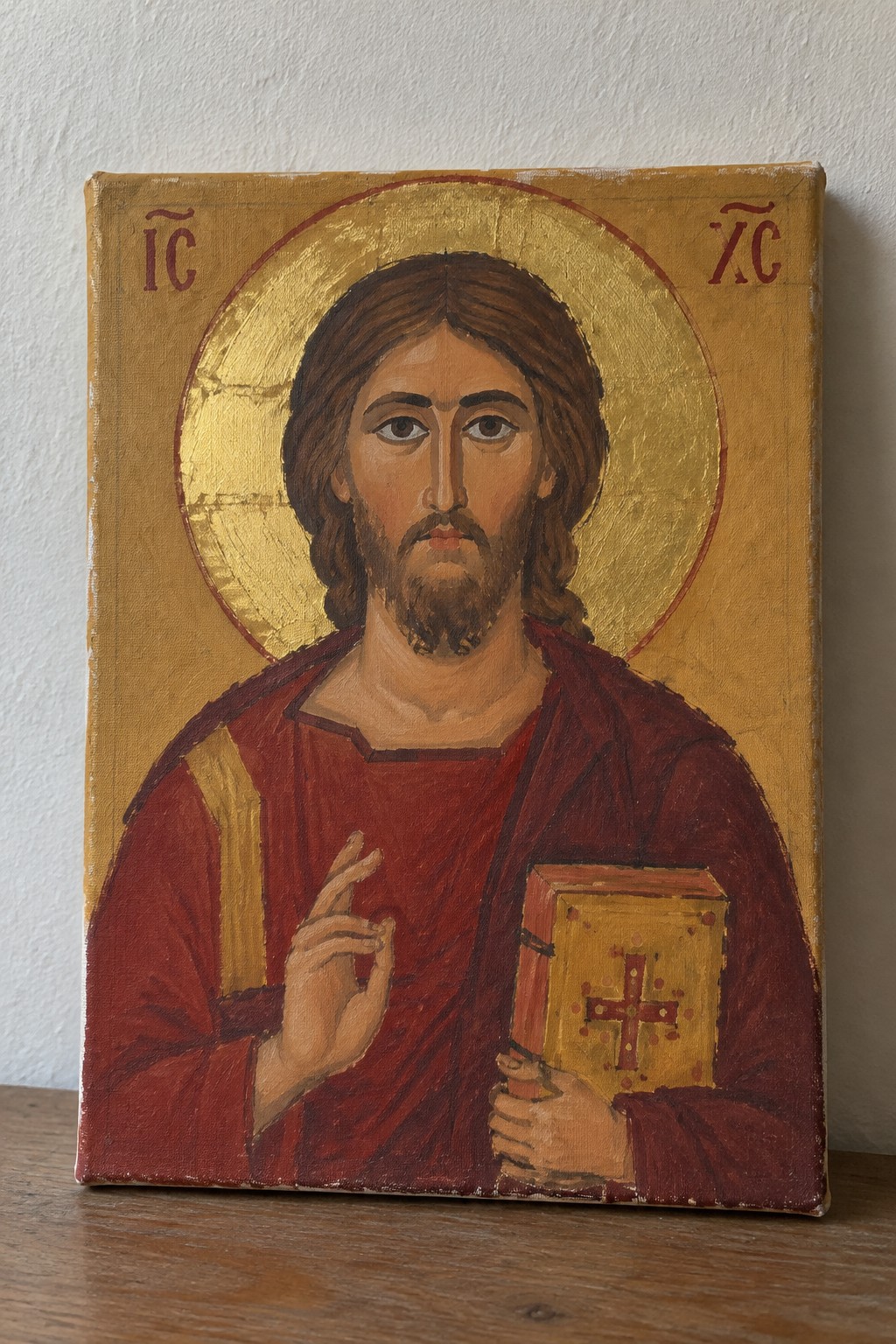
A centered portrait of the risen Christ in classic Byzantine icon style works as a devotional painting idea built around strong symmetry and a limited palette of deep reds, warm earth tones, and gold. The composition places the figure frontally with a raised blessing hand on one side and a decorated book on the other, keeping the gold halo as the main unifying element. This approach belongs to the sacred icon category and relies on clear outlines plus flat color areas rather than shading or perspective.
The composition does a lot of the work here because the balanced placement of the hand and book creates natural focal points that guide the eye without extra details. You can adapt the same layout for smaller Easter cards or larger wall pieces by adjusting only the scale of the gold circle and robe folds. For practice, the idea is useful because the main shapes stay simple while still allowing room to experiment with metallic paint or subtle texture on the book cover. A version like this stands out on Pinterest when the red and gold stay bold and the background stays plain.
Risen Christ at the Empty Tomb
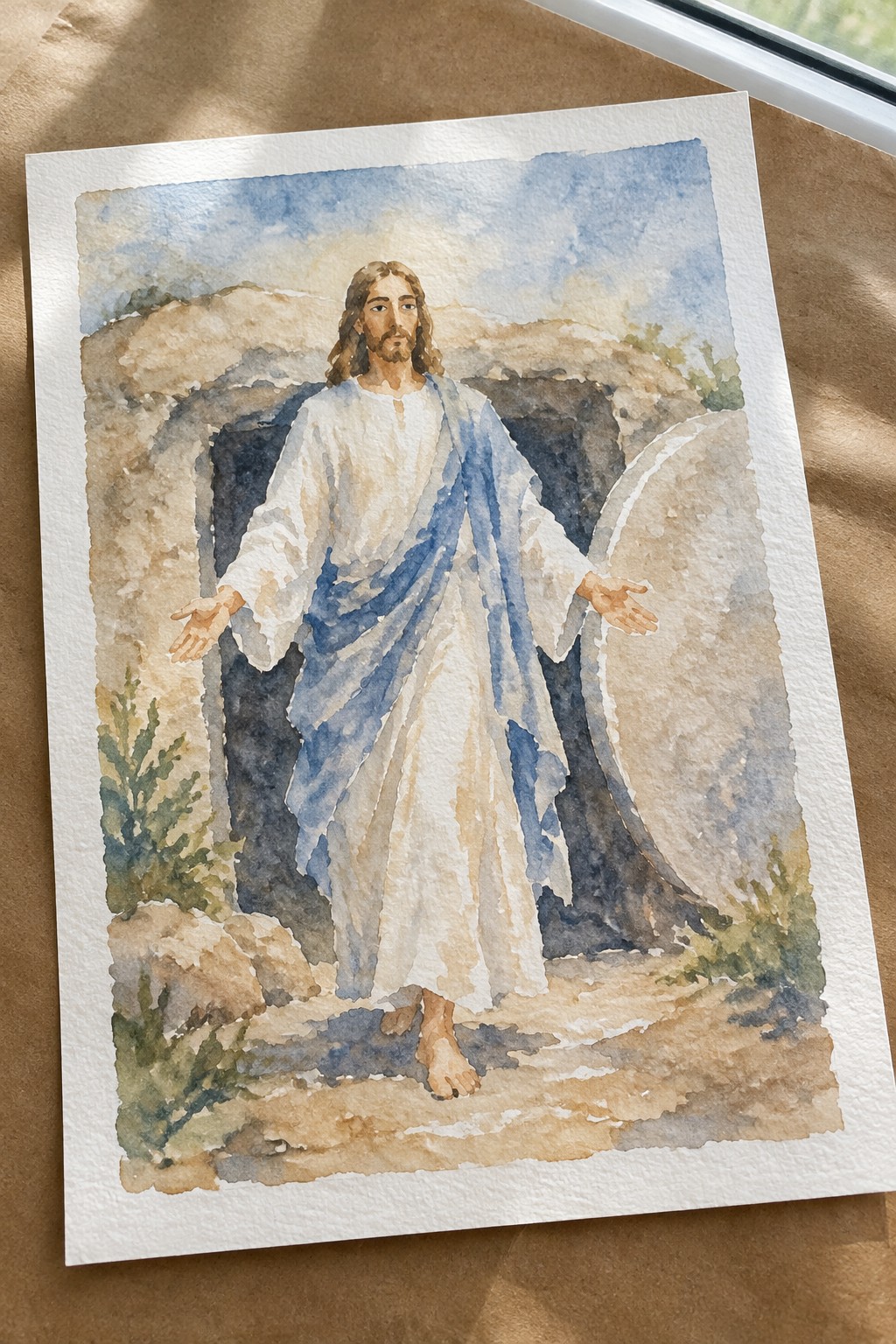
A resurrection painting built around a standing figure with open arms placed directly in front of an empty cave entrance gives the composition a clear vertical focus. The rocky forms on either side create natural framing that keeps the eye on the central pose while the lighter sky prevents the top of the page from feeling heavy. Earthy browns and muted greens in the ground and vegetation balance the pale robe and blue sash so the figure stays prominent without extra contrast work.
What makes this idea useful is the simple central placement that works on both large paper and smaller sketchbook pages without major changes. You could drop the background detail to a few broad rock shapes if you want a faster version or swap the watercolor for gouache to get more solid color coverage. The limited palette of off-whites, blues, and browns also makes it straightforward to repeat in a series or match with other Easter pieces for a cohesive wall set.
Byzantine Risen Christ with the Resurrection Banner
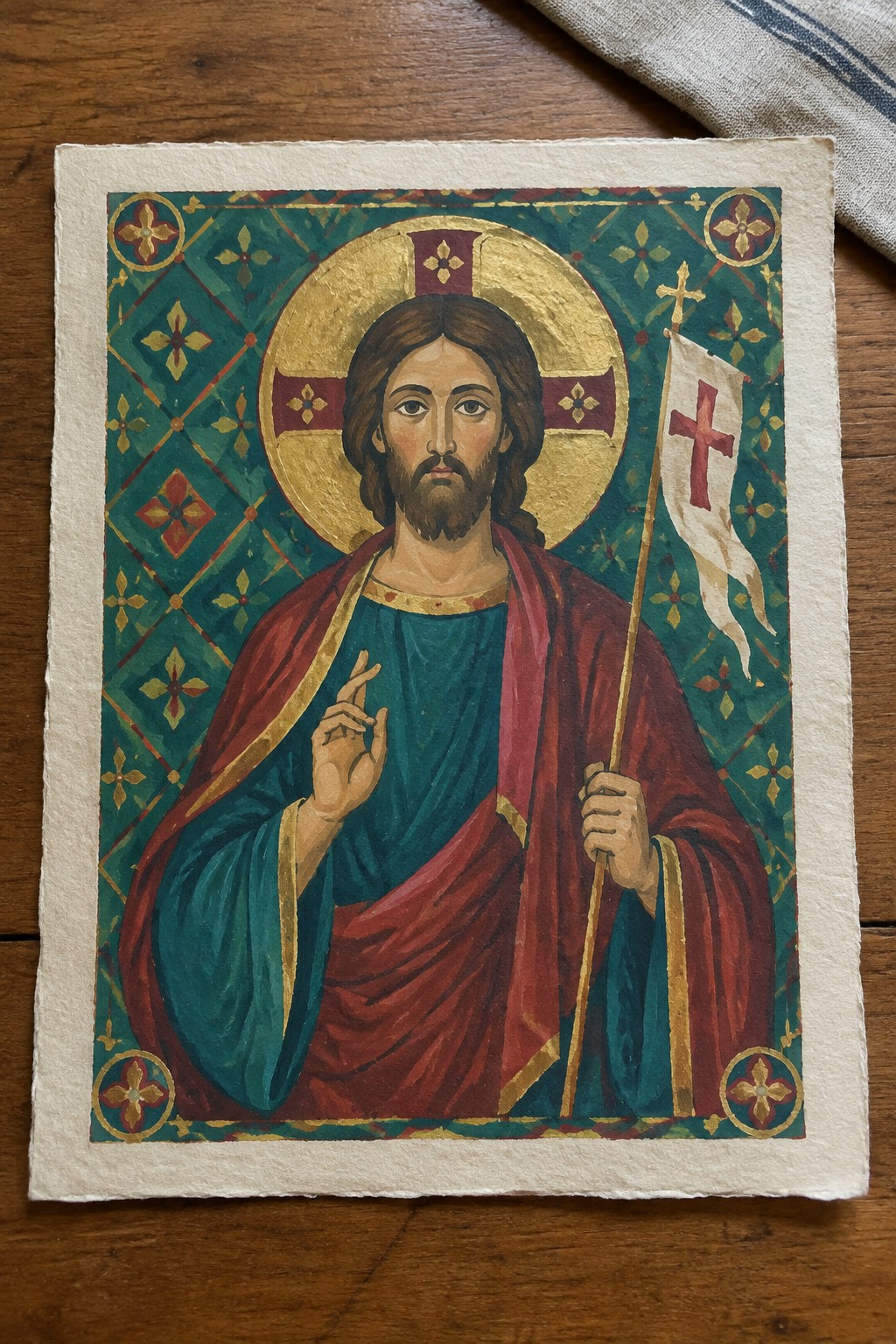
A full-figure icon of the risen Christ forms the core idea here, painted in the flat, stylized manner of traditional Byzantine icons with a large gold halo and raised blessing hand. The figure holds a white banner marked with a red cross, set against a repeating teal and gold geometric pattern that fills the space evenly around the subject. This approach fits the category of sacred decorative religious art, where strong outlines, symmetrical borders, and limited depth keep the focus on the central figure rather than realistic space.
The composition does a lot of the work here by placing the figure in the middle with clear borders and a bold halo that makes the subject easy to read even at smaller sizes. The repeating background pattern adds visual interest without requiring complex shading or perspective, so the same layout works for both detailed versions and quicker studies. This kind of icon adapts well for Easter pieces because the banner element can be swapped or simplified, and the limited color palette of red, teal, and gold makes it straightforward to match with other seasonal decorations. For wall art or gifts, the balanced layout stands out on Pinterest because it reads clearly in thumbnails.
Folk Art Christ with Haloed Bird Angels

A central risen Christ figure stands with both hands raised against a deep blue background scattered with gold stars and crosses. Four small bird-shaped angels with halos and colorful wings circle the figure, creating a symmetrical arrangement that keeps the eye focused on the middle. The idea works as decorative religious art through its bold shapes, limited color palette of blue, gold, orange, and white, and simple outlines that prioritize clear symbols over realistic detail.
The composition does a lot of the work here because the central placement and surrounding angels create instant balance without needing complex perspective. You could easily adapt the size for a greeting card or scale it up for a wall piece by keeping the same star-filled background and swapping in different accent colors. For practice, this kind of subject helps with painting clean halos and even spacing of repeated elements, and the strong contrast makes it stand out quickly when shared on Pinterest.
Risen Christ in a Gold Mandorla on a Green Field with Crosses
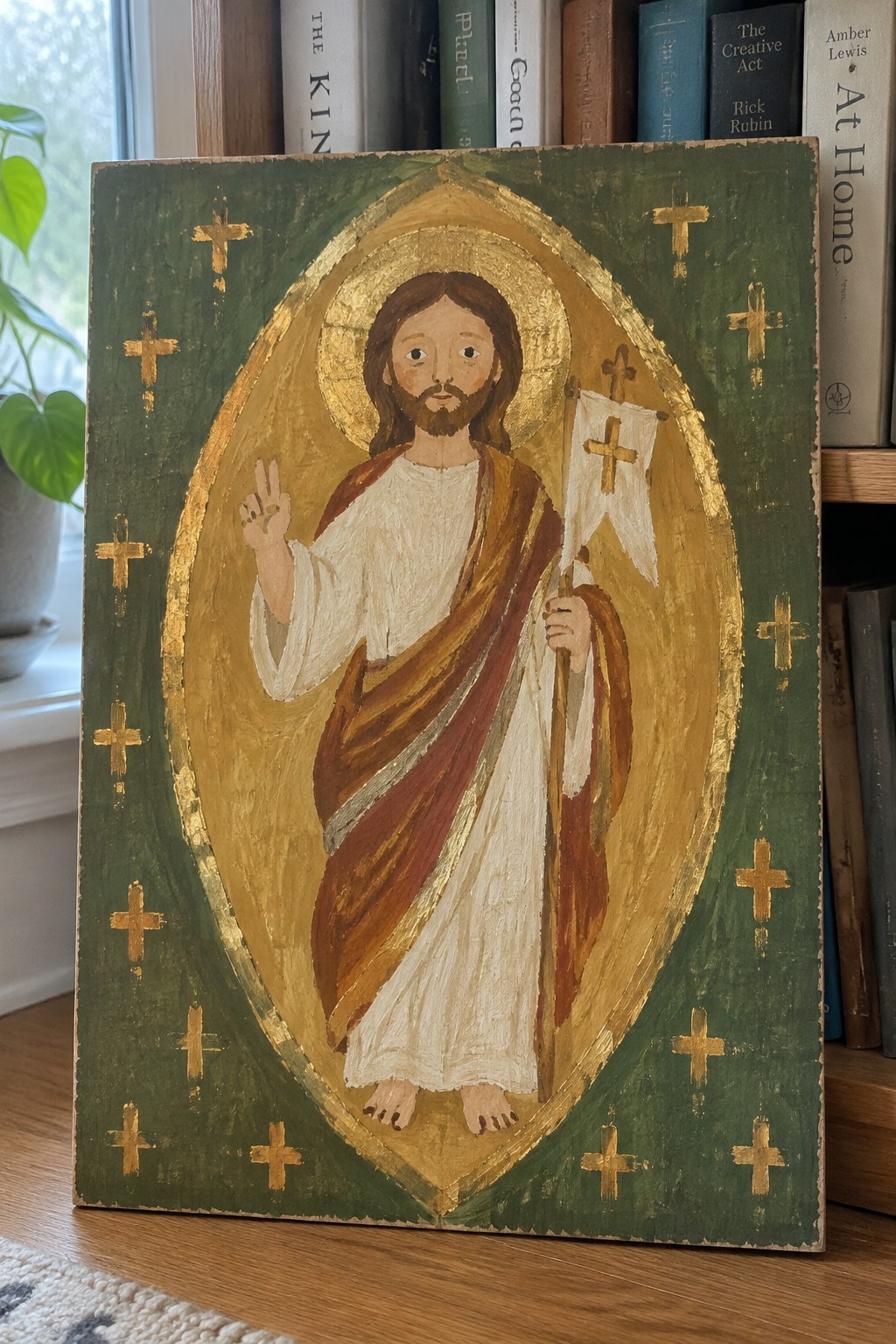
The painting idea places the risen Christ in a frontal pose inside a large gold oval against a solid green background. He holds a white banner with a cross on a staff in one hand and raises the other in a blessing gesture, while small gold crosses are scattered around the edges. The strong symmetry, limited color range of green and gold, and simple repeating shapes make the design read clearly as a decorative religious piece suitable for Easter.
What makes this idea useful is the way the oval frame and scattered crosses create structure without needing complex details. The color palette stays easy to match or adjust for different room styles, and the number of background crosses can be reduced or rearranged depending on the canvas size. For seasonal wall art or a quick practice piece, the bold shapes and flat areas of color help the design hold up even if the brushwork stays loose.
Watercolor Portrait of Christ with Crossed Gold Halo

A half-length portrait idea shows Christ with shoulder-length hair and a short beard, painted in soft neutral washes that build subtle shading on the face and neck. The composition centers a large gold circle with horizontal and vertical lines behind the head, while thin gold trim follows the folds of a muted pink robe and sage green mantle. This keeps the religious symbol as the main visual anchor while the loose brushwork and limited palette hold the rest of the piece together.
What makes this idea useful is how the halo and gold lines do most of the compositional work, so you do not need a detailed background. The vertical crop and simple color mix make it easy to resize for greeting cards or small canvases, and you can swap the robe tones or skip real gold leaf for a painted version. For Easter projects, the same layout works as a standalone piece or as part of a series with other saints.
Christ Rising Above the Fallen Guards in Decorative Style

This painting idea centers on the resurrection moment with Christ positioned upright on the tomb lid and two guards collapsed at the base. The composition uses a strong vertical layout that places the central figure high in the frame while the lower section holds the horizontal line of the guards and their round shields. Flat color areas, repeating floral borders, and simple geometric patterns keep the design balanced and readable even at small sizes.
What makes this idea useful is the clear layering of three distinct zones: the upper arch, the middle tomb, and the bottom figures. The repeating border motifs and shield shapes can be scaled down or simplified without losing the overall structure, which makes the idea workable for both larger wall pieces and smaller greeting card formats. The limited palette of reds, yellows, and teal also translates easily to different paper types or even fabric prints for seasonal Easter projects.
Byzantine Portrait of Christ Giving the Blessing

A half-length devotional portrait centers the risen Christ against a solid gold background with a thin halo. The figure wears a white tunic draped with a red mantle and raises the right hand in a two-finger blessing gesture. This type of sacred art idea works because the tight framing and flat gold field keep attention on the face and hand without extra elements.
The composition does a lot of the work here by letting the gold background handle the light and mood. A painting like this works especially well for Easter seasonal pieces or small devotional panels that fit on a shelf or wall. The limited palette makes it straightforward to try on canvas or wood, and the idea can be adapted by softening the red mantle or changing the halo line to a different width. For practice, this kind of subject builds control with skin tones and simple fabric folds.
Centered Risen Christ with Radiant Halo and Lilies

A standing figure of Christ with arms extended wide forms the clear center of this painting, set against a flat blue field with a large yellow halo and straight rays spreading outward. White lilies on green stems flank the figure on both sides while small yellow crosses are placed at different heights to fill the space without crowding it. The limited color palette and repeated shapes keep the whole piece balanced and easy to read from a distance.
The composition does a lot of the work here by using symmetry and a solid background so the main figure stays the focus. You can scale this down for a small wooden panel or switch the blue to a deeper tone if you want more contrast with the halo. The simple shapes and repeated flower motif make it straightforward to adapt for different sizes or to personalize with different bloom types while keeping the same layout. For seasonal wall pieces this kind of clear, graphic approach tends to read well even when kept small.
Christ at the Ancient City Gate
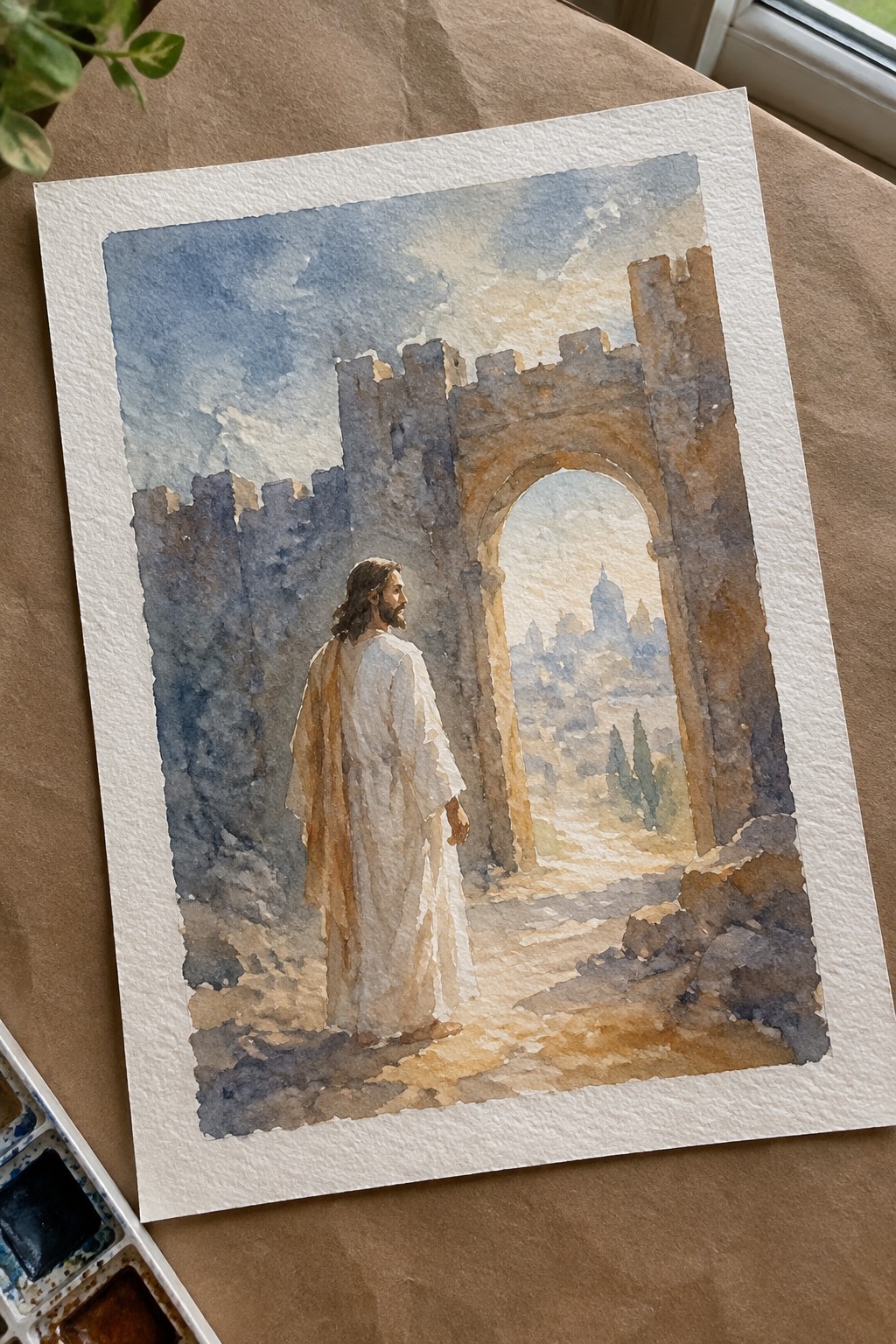
The painting idea places the risen Christ in a side profile, standing on a rocky path just outside a large stone archway that opens toward a distant city. The arch serves as the main structural element, framing the view while the figure occupies the lower left portion of the scene in simple robes. A limited palette of cool blues, warm browns, and soft ochres keeps the focus on the contrast between the solid stonework and the lighter sky beyond.
What makes this idea useful is the built-in framing device that does most of the compositional work, so the figure itself can stay straightforward. The same layout works at different sizes, whether for a full sheet or a smaller study, and the earthy color range adapts easily if you want to shift toward cooler or warmer tones. For seasonal pieces, this kind of gateway view gives a clear Easter connection without requiring intricate details on the figure.
Balanced Three-Figure Icon with Christ at the Center

This painting idea uses a classic icon layout where the risen Christ stands front and center in a blue and white robe, with two smaller haloed figures positioned symmetrically on either side. The composition relies on strong vertical alignment and a repeating floral border to keep the eye moving inward toward the main figure. It works as decorative religious art that blends traditional Byzantine structure with a soft, hand-painted color approach.
What makes this idea useful is the built-in symmetry that makes layout decisions easier from the start. The side figures can be swapped for other saints or simplified into basic shapes if you want a quicker version, while the border pattern offers a chance to practice repeating motifs without needing perfect realism. A painting like this works especially well for wall pieces meant for Easter or year-round devotional spaces, and the contained color scheme keeps it practical to recreate on different canvas sizes.
Frontal Portrait with Radiating Halo and Cross

A close-up devotional portrait of the risen Christ works by placing the face front and center with a large halo that includes a wooden cross and golden rays spreading outward. The idea relies on a simple color contrast between the warm skin and robe tones and the deep blue textured background to keep attention on the figure. This fits the category of sacred seasonal portraiture where the halo structure itself carries most of the visual weight.
What makes this idea useful is how the centered layout and limited background keep the painting easy to scale down for smaller canvases or cards. You can reduce the rays to fewer lines or soften the background texture if you want a quicker version for practice. For Easter wall pieces or gifts, the traditional halo elements make the religious theme clear right away, so the painting reads well even in a small thumbnail on Pinterest.
Byzantine Christ Icon with Gospel Book and Floral Border
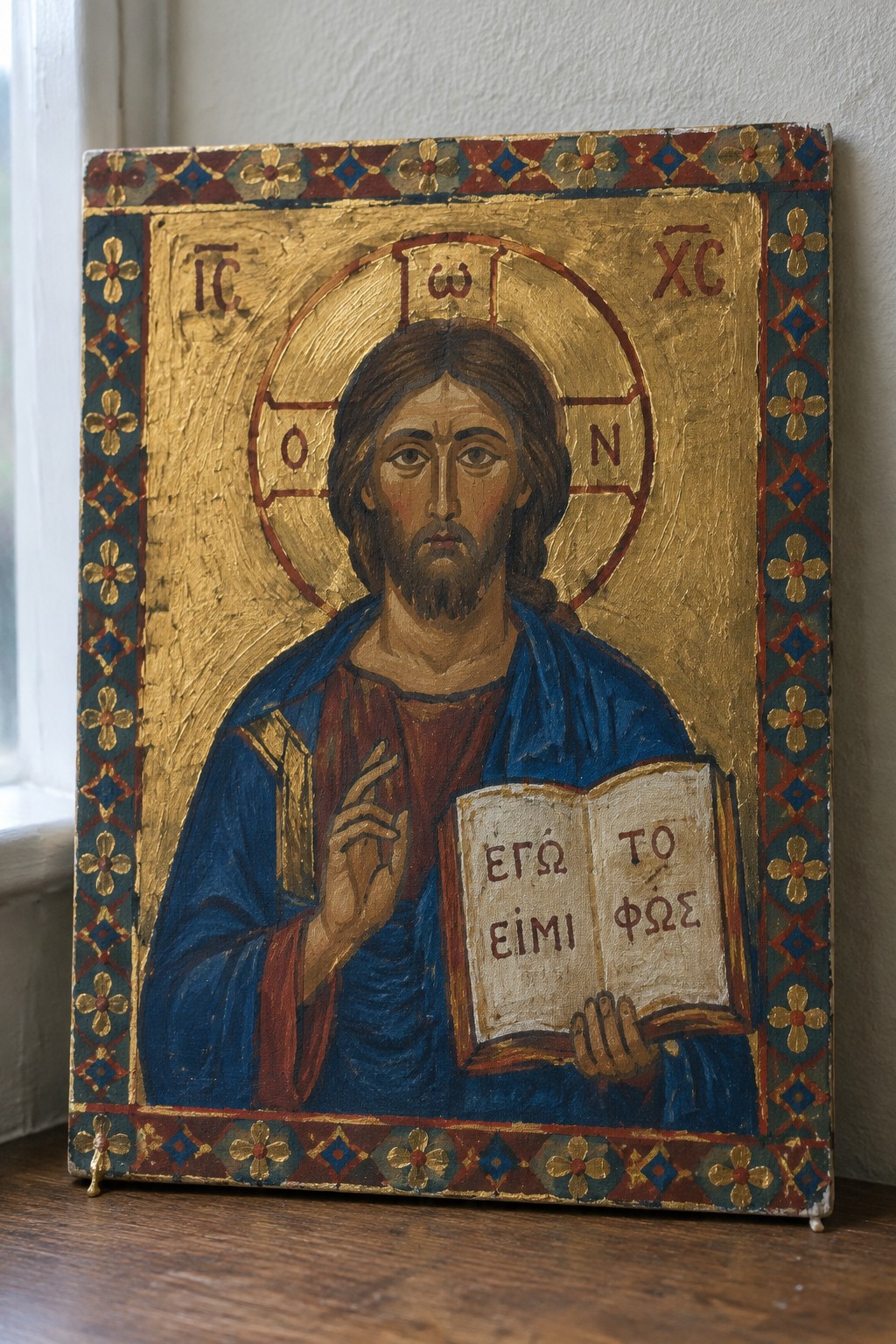
A solid painting idea for Easter uses a frontal Christ figure holding an open book that displays the Greek words for “I am the light,” with one hand raised in a clear gesture. The idea relies on a centered, symmetrical layout against a gold field, framed by a repeating pattern of flowers and shapes along the edges. Deep blue and red robes against the warm background keep the whole piece balanced and easy to read from a distance.
The composition does a lot of the work here by keeping the figure centered and the background uncluttered. You can adapt the border width or simplify the repeating motifs if you want to finish the piece faster on a smaller panel. For wall art or seasonal displays, the book text gives the subject a direct connection to the Easter theme without needing extra symbols or figures.
Risen Christ in a Striped Mandorla
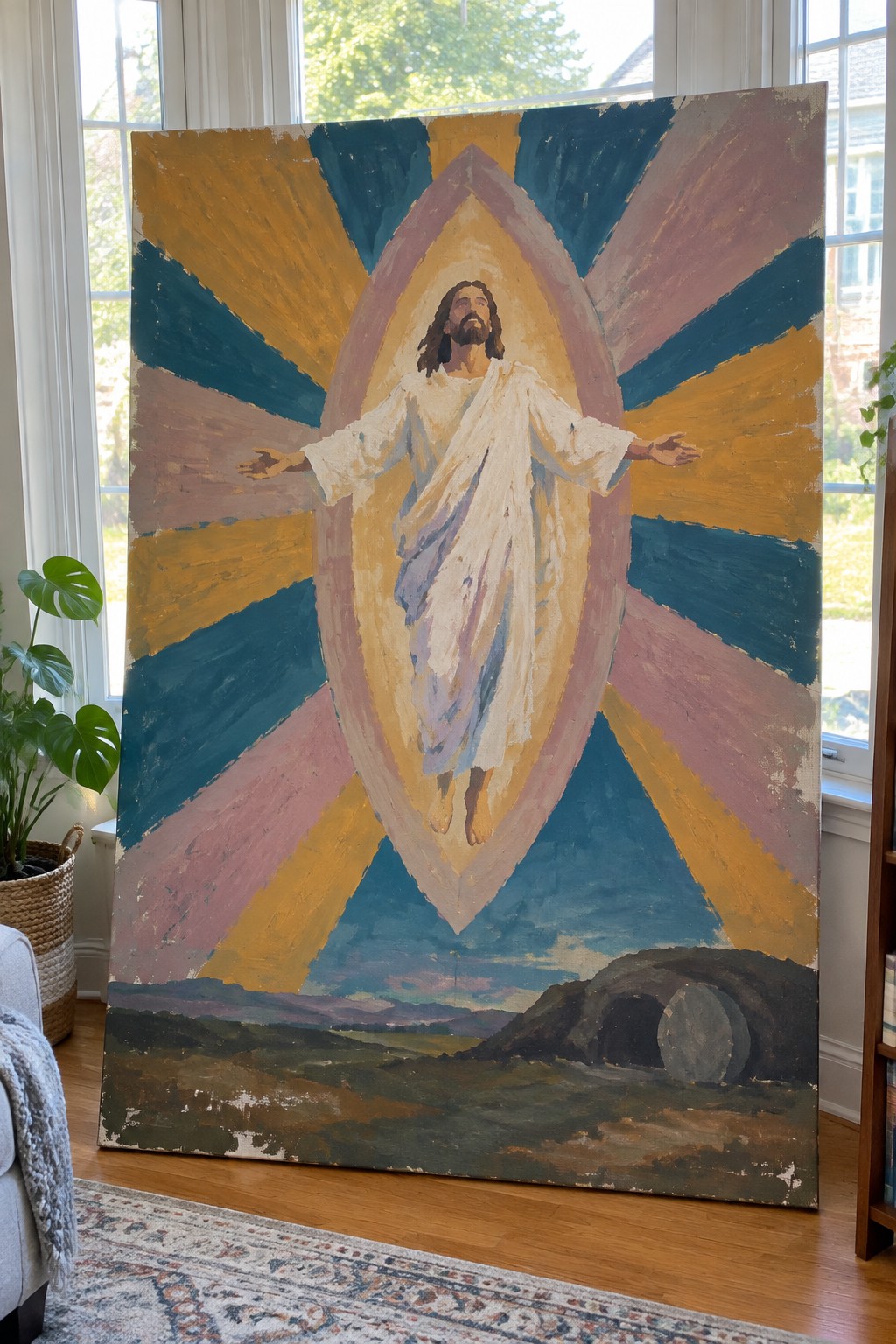
This painting idea centers on the Risen Christ held inside a large mandorla built from wide radiating stripes in mustard, teal, rose, and muted gold. The figure floats high in the oval with arms open, while the lower third drops into a landscape that includes a hillside and an open tomb. The strong vertical split between the geometric mandorla and the grounded scene below creates a clear focal point without needing fine detail or complex perspective.
What makes this idea useful is the built-in division that lets you keep the mandorla bold and graphic while treating the tomb area as a simpler landscape study. You can shrink the whole piece to a smaller canvas by cropping just below the mandorla or expand the stripe pattern to fill a larger wall. The limited set of earthy colors also makes it straightforward to swap in different shades or reduce the rays to fewer bands if you want a quicker version for practice or seasonal decor.
Watercolor Portrait of Christ with Crossed Gold Halo

This painting idea uses soft watercolor layering to create a centered portrait of Christ, with skin tones built from light browns and muted reds while the hair flows in loose, wavy strokes. The gold halo stands out as the main structural element, drawn as a clean circle with intersecting lines that reference traditional icon crosses without needing extra detail. The result sits comfortably in the category of decorative religious portraiture, where the limited palette and balanced face placement keep the whole piece readable even at small sizes.
What makes this idea useful is how the halo can be swapped for thinner lines or different metallic shades depending on available supplies. The vertical crop and neutral background make it simple to resize for greeting cards or journal pages without losing impact. For practice, blocking in the face first and treating the halo as a final accent layer keeps the process manageable while still delivering a finished piece that reads clearly on a Pinterest board.
Good Shepherd Portrait with Lamb and Side Borders
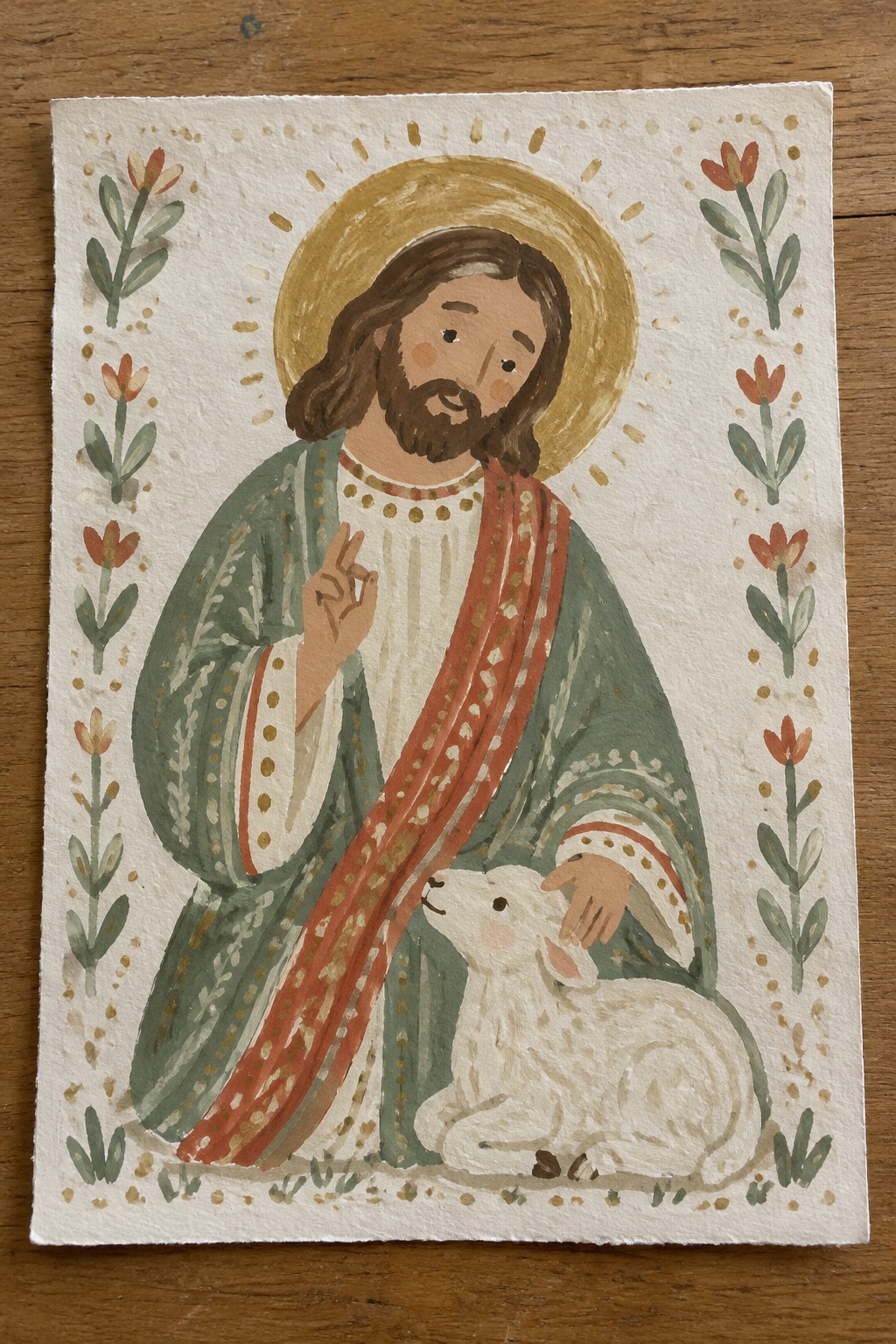
This painting idea centers on a calm central figure of Christ with a resting lamb at his feet, using the raised hand and gentle downward gaze to guide attention through the composition. Vertical floral borders on both sides create a natural frame that balances the scene and adds decorative rhythm without crowding the main subjects. The soft, blended color palette and rounded shapes make it a strong example of seasonal devotional art that combines religious iconography with simple illustrative styling.
The composition does a lot of the work here by keeping the lamb and figure as clear focal points while the borders add interest at the edges. You could easily adapt the scale for a small canvas, a journal cover, or a printable Easter card by shortening the borders or swapping in different flower shapes. The muted greens and warm terracotta tones also translate well if you want to shift the palette to match existing decor. For practice, this kind of subject helps build skills in layering soft washes and placing secondary elements without overcrowding the center.
Risen Christ in Golden Light with Empty Tomb
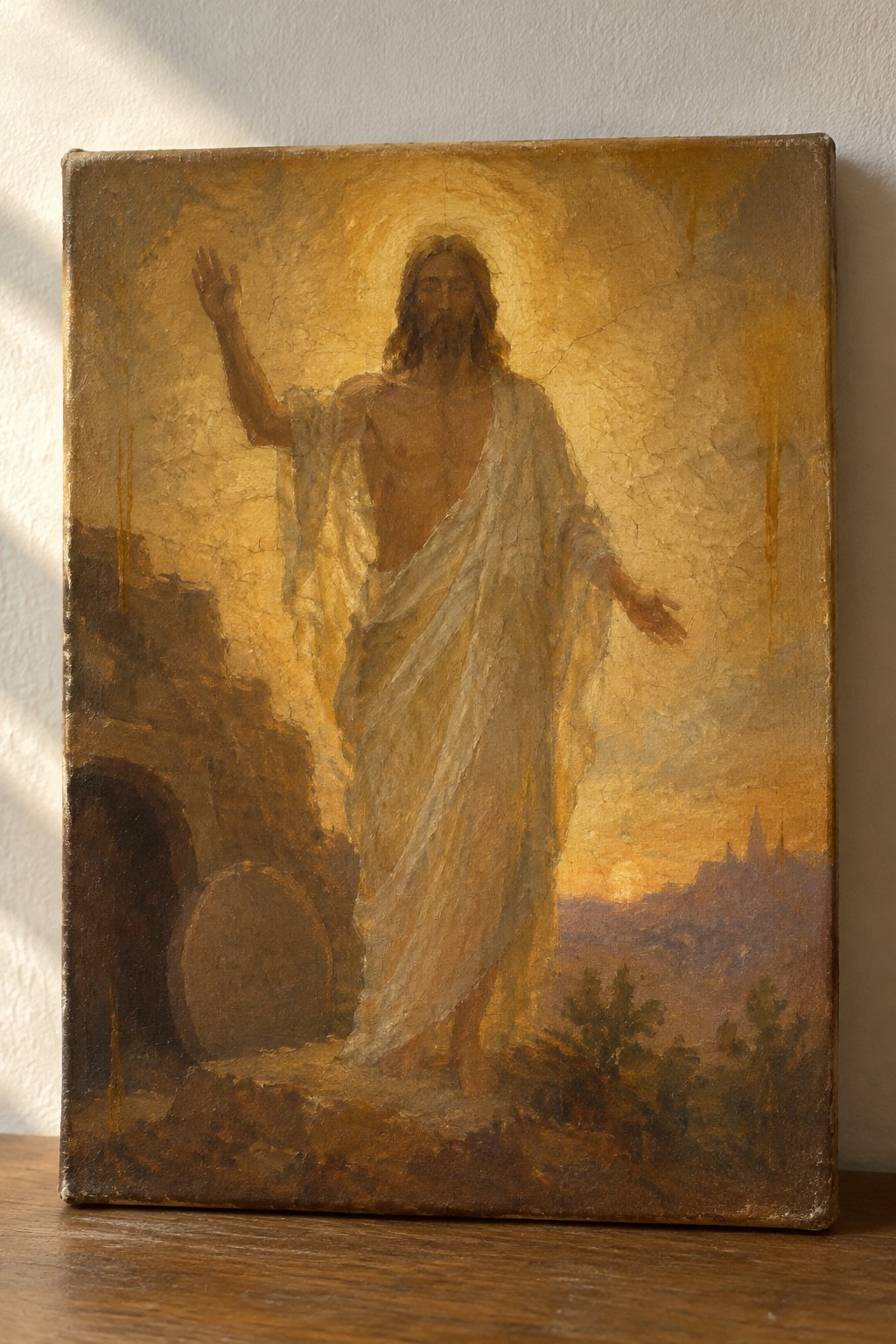
This painting idea centers on the risen Christ as the main subject, positioned upright with one hand raised and robes catching the light, set against a warm sunrise that includes the open tomb and distant hills. The composition works by placing the glowing figure slightly off center so the eye moves from the halo down through the flowing drapery toward the landscape elements without losing focus on the person. It belongs to seasonal religious art, where soft blending and a limited palette of golds, browns, and creams keep the emphasis on light and presence rather than sharp outlines.
What makes this idea useful is the clear separation between the bright central figure and the simpler background shapes, which lets you adjust the size of the landscape or drop it entirely for a tighter study. The warm color range translates well to different surfaces and can be scaled down for greeting cards or kept large for wall pieces. For practice, the loose handling of light and fabric gives room to experiment with edges while still keeping the subject recognizable.
Byzantine-Style Portrait of Christ with Blessing Gesture and Book

A half-length portrait of the risen Christ forms the core of this painting idea, with one hand raised in blessing and the other holding a decorated book. The composition stays balanced through a large central figure, a gold halo, and an arched frame that draws attention inward without extra detail. Deep blue and coral red robes against the dark background keep the color scheme simple while making the figure stand out clearly.
What makes this idea useful is the built-in symmetry that works at different sizes for prints or small panels. The border pattern can be reduced to basic lines if time is short, or kept as is for a more finished look. For Easter work this layout adapts well because the main shapes stay the same even if the robe colors shift to fit a different palette. The clear focal point also makes it easy to place on a wall without competing with other pieces.
Watercolor Resurrection with Byzantine Mosaic Detail

This painting idea combines the risen Christ as the central figure with a rolled-away stone tomb and an arched mosaic accent drawn from Byzantine traditions. The figure stands in soft robes against a landscape background while the mosaic pattern adds a decorative layer in the upper right without crowding the main subject. The approach works as seasonal religious art that mixes figure painting with simple decorative elements.
What makes this idea useful is how the mosaic section can be scaled down or replaced with a solid color block for a quicker version. The gentle landscape and open space around the figure make it straightforward to adapt for different canvas sizes or to crop into a vertical format for prints. For practice, this kind of subject lets you work on drapery and basic proportions while adding one decorative detail for interest. The color palette of muted greens, blues, and gold tones stays easy to match with other Easter pieces.
Frequently Asked Questions
What is the significance of the Byzantine style when depicting the risen Christ at Easter?
Byzantine-inspired art emphasizes flat perspectives, gold backgrounds, and elongated figures to convey spiritual rather than physical reality. This approach helps viewers focus on the divine triumph of the resurrection rather than historical details, making the risen Christ appear timeless and majestic. Such paintings often include inscriptions in Greek or Church Slavonic to reinforce their sacred purpose during Easter celebrations.
How do these paintings typically show the moment of Christ’s resurrection?
Many Byzantine-inspired works portray the risen Christ standing atop the broken gates of Hades while holding a cross or banner, symbolizing victory over death. He is frequently shown in radiant white or gold robes surrounded by angels or the liberated souls of the righteous, drawing from ancient liturgical texts. This visual narrative invites reflection on personal renewal during the Easter season.
Are the 19 paintings modern interpretations or based on historical originals?
These works blend traditional Byzantine techniques with contemporary craftsmanship, often created by modern iconographers who study ancient prototypes from monasteries like those on Mount Athos. They are not direct copies of medieval pieces but faithful revivals that preserve core elements such as reverse perspective and symbolic colors while adapting them for today’s worship spaces or home altars.
What practical steps can help someone appreciate or pray with these images during Easter?
Begin by lighting a candle and reading the relevant Gospel passage aloud before the painting. Notice details like the mandorla of light around Christ or the empty tomb to deepen meditation on resurrection hope. Many people keep printed reproductions near their prayer corner and return to one image each day of Holy Week for focused contemplation.
Where might someone obtain high-quality reproductions or prints of these 19 paintings?
Specialized religious art suppliers and Orthodox Christian bookstores often carry giclee prints on wood or canvas that mimic the original egg tempera technique. Online galleries affiliated with Byzantine icon studios provide options in various sizes, and some monasteries sell authorized versions with proceeds supporting their communities. Always verify that the source respects the sacred nature of the imagery.