I have spent some time looking at Renaissance style paintings lately.
The ones with fallen angels stand out because of how the artists show the change in mood and setting.
I have tried painting angels myself a few times and I can see why these scenes are interesting to work on.
I found twenty one examples that seem to fit what I was searching for.
Fallen Angel Seated on Broken Stone Steps

A solid painting idea here is a dramatic fallen angel shown as a muscular winged male figure in a seated pose on crumbling stone architecture. The concept uses the large wings and flowing blue drapery to balance the composition while the upward gaze and stormy sky create a clear focal point. This fits the dramatic figurative category with Renaissance influences through its realistic anatomy, classical ruins, and limited earthy color palette.
What makes this idea useful is the strong central figure that carries the composition even if the background stays simple. The pose and wing placement give clear structure for practice while the blue fabric and stone tones can be swapped for other colors to match different rooms or projects. For wall pieces this works because the single figure stands out without extra details, and the same setup can be scaled down to a sketch or adjusted by changing the angle of the steps.
Renaissance Angel Portrait with Soft Layered Washes
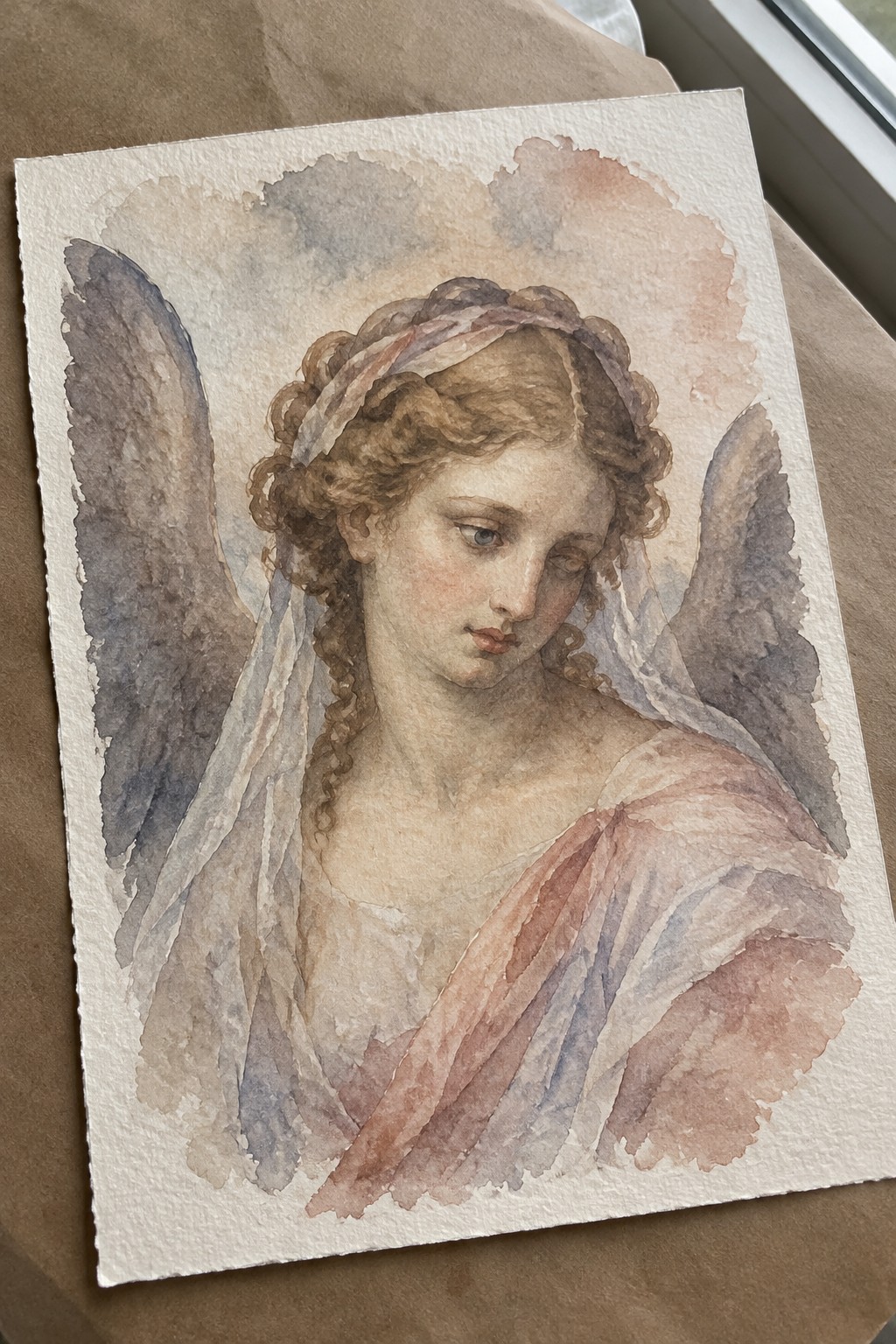
This painting idea centers on a close-up portrait of a winged female figure rendered in a Renaissance style. The concept uses translucent watercolor layers to build soft transitions in the hair, veil, and fabric while keeping the wings as broad, muted shapes that frame the head and shoulders. The downward gaze and three-quarter turn of the head create a natural focal point without needing sharp details or dramatic lighting.
What makes this idea useful is the limited color range of muted browns, pinks, and grays that can be mixed from just a few tubes. The loose background wash removes the need for precise edges, so the same layout works on smaller paper for practice or larger sheets for finished pieces. This framing also translates well to acrylic or gouache if you want more control over the fabric folds. For Pinterest, the combination of recognizable angel imagery with a gentle color scheme tends to save well in both classical art and watercolor boards.
Reclining Fallen Angel on Stone Steps

A fallen angel in a reclining pose on classical stone steps makes a strong central subject for a Renaissance-style painting. The idea centers on the figure’s angled body, large wings, and contrast between the white drapery and deep red cloth against a simple architectural background. This setup keeps attention on the form while the sky and columns provide just enough setting without crowding the scene.
What makes this idea useful is how the diagonal composition guides the eye naturally across the figure. The pose works for different canvas sizes since the main elements stay contained even if the background gets simplified. Changing the fabric colors or wing angle lets you adapt it for various palettes while keeping the same dramatic feel. For practice, this subject builds skills with folds and anatomy without requiring complex details.
Profile Portrait of a Fallen Angel with a Single Tear

A fallen angel portrait idea works by centering on a tight profile view that highlights the face, neck, and a single visible tear. The composition relies on soft directional lighting and a restrained earthy palette to pull attention straight to the expression without extra elements. This approach fits the dramatic Renaissance-style figurative category, where realistic skin rendering and subtle wing detail support the overall mood.
What makes this idea useful is the cropped framing that removes the need for a full scene, letting you focus practice on skin tones and light falloff. The muted background and limited color range adapt easily to smaller canvases or different warm palettes if you want to change the mood. For wall pieces, the vertical crop and single focal point make it simple to hang as a standalone work that holds attention without competing elements.
Fallen Angel Supported by a Child Angel in Ruined Arches

A large winged figure reclining in exhaustion while a smaller winged child leans in close forms the core of this painting idea. The composition uses the broken arch as a natural frame to hold attention on the two figures, with the extended wing and tilted head creating clear directional lines across the canvas. Earthy browns and muted reds against a soft sunset sky give it the dramatic contrast typical of Renaissance narrative scenes.
The composition does a lot of the work here because the arch and columns already organize the space and keep the focus tight. You could adapt it by cropping tighter around the figures for a smaller canvas or shifting the sky to deeper blues for a cooler evening mood. For practice, this kind of subject works well as a study in figure proportion and simple drapery folds without needing complex backgrounds.
Fallen Angel with Broken Harp

A strong fallen angel idea centers on a curled winged figure beside a shattered harp, using the broken instrument and flowing drapery to anchor the lower half of the composition while the wings create height and contrast. This approach works well as a narrative Renaissance-style piece because the diagonal body position and scattered harp pieces naturally lead the eye without extra elements. The cool blue and gold palette keeps attention on the figure and the ruined background shapes.
What makes this idea useful is how the central figure and foreground objects carry most of the visual weight, so the background ruins can stay loose and simple. The color choices make it easy to shift toward warmer tones or keep the cool range for a more somber result. For practice, this subject builds skill with fabric folds and wing structure while the broken harp adds interest without requiring perfect symmetry. A painting like this translates well to smaller canvas sizes or even sketchbook studies.
Fallen Angel Resting on a Stone Ledge

A fallen angel painting idea works by placing a single seated male figure with large contrasting wings at the center of the composition. One wing appears dark and heavy while the other stays lighter, creating a clear focal point against the open sky and distant ruins. The landscape with cypress trees and crumbling structures supports the figure without competing for attention, and the overall color range stays muted with earthy greens and browns.
What makes this idea useful is the strong central pose that holds the painting together even if the background stays simple. The wings give instant drama so the rest of the scene does not need many extra details. For practice, the same idea can be scaled down by keeping the figure large and reducing the landscape to a few soft shapes. The muted palette also makes it easy to adapt for different canvas sizes or to match existing room colors.
Fallen Angel Holding a Large Quill

A seated winged figure forms the core of this painting idea, shown in a hunched posture with one large wing visible and a oversized feather or quill held close to the torso. The idea belongs to dramatic figurative angel art in a Renaissance vein, where the main visual interest comes from the contrast between the broad wing shape and the long diagonal of the feather. Earthy browns and soft transitions keep the focus on the body and hands rather than on any background detail.
What makes this idea useful is the strong central silhouette that works at different sizes without losing impact. The limited palette makes it practical for practicing shading and edge control before adding more color. You can simplify the wing detail or change the feather to a different object if you want a quicker study or a more personal version for wall decor.
Kneeling Angel with Moonlit City View
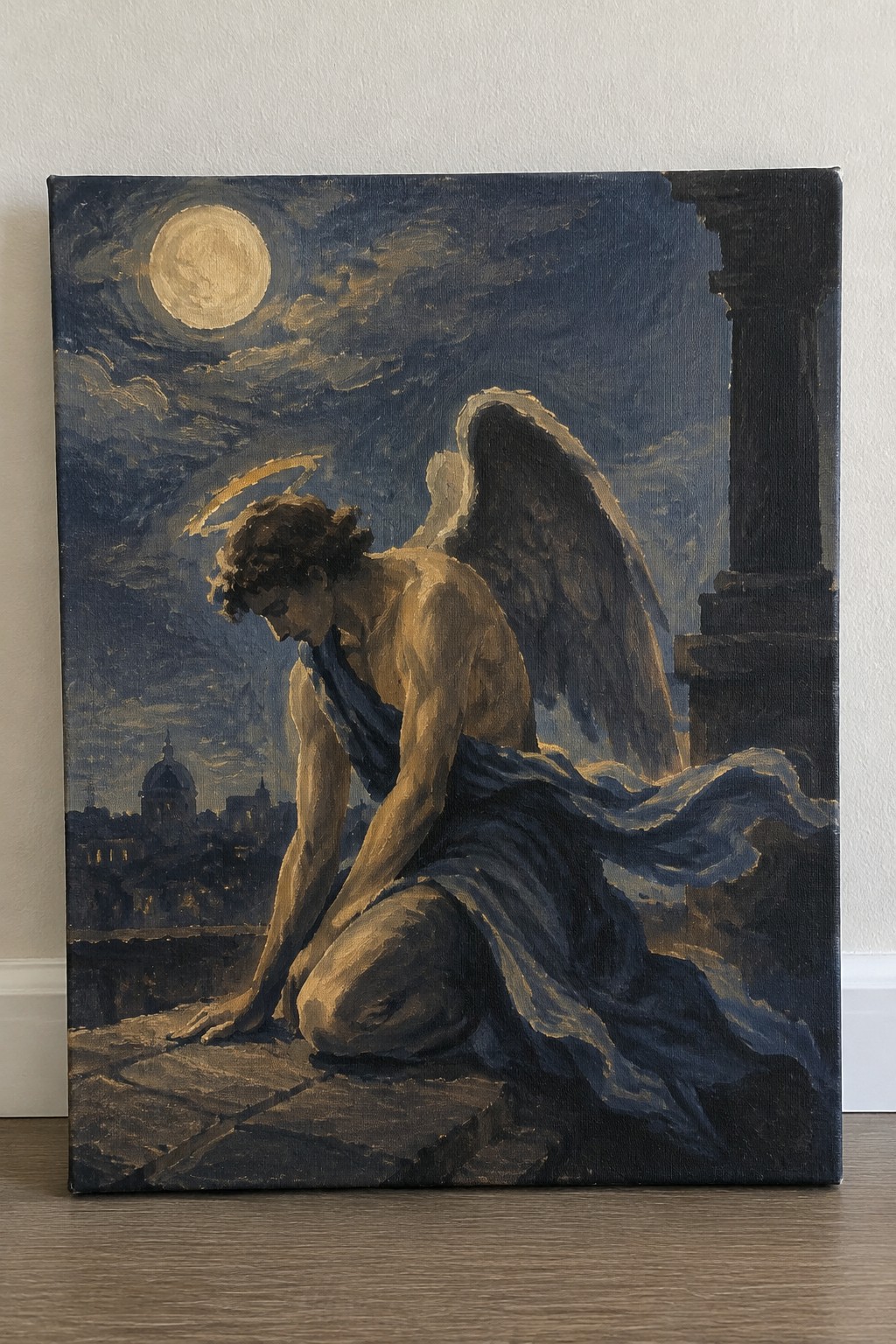
A fallen angel figure kneels on a stone ledge at night, head lowered and one hand resting on the surface for support. The composition places the angel off-center against a deep blue sky, with a full moon providing the main light source and a distant cityscape filling the lower background. Strong contrast between the lit upper sky and the darker architectural forms below keeps the eye moving from the figure outward to the horizon.
What makes this idea useful is the clear separation between the main subject and the background layers, which lets you adjust the city detail without losing the overall mood. You can swap the specific skyline for any location or reduce it to a few simple rooflines if you want a faster study. The limited palette of blues and muted golds also makes it straightforward to test different lighting effects or scale the piece down for a smaller canvas.
Fallen Angel Caught Mid-Descent Through Layered Clouds

A winged male figure in a twisting pose drops through dense, overlapping cloud masses with one arm extended upward. The idea centers on strong diagonal lines from the limbs and body to suggest motion against a heavy, atmospheric backdrop. This type of dramatic figurative work suits Renaissance-style studies that focus on anatomy and cloud effects rather than detailed settings.
What makes this idea useful is how the clouds already handle most of the background work, leaving the figure as the clear center. You could simplify the wing details or shift the palette toward warmer browns if you want a different mood. For practice, the subject gives solid experience with foreshortened limbs and soft edges without requiring extra elements. A painting like this also translates well to smaller formats for wall pieces or sketchbook pages.
Fallen Angel Holding Laurel Wreaths

A solid fallen angel idea centers on a winged figure with curly hair and a golden halo, shown holding two laurel branches while wearing torn white drapery. The downward gaze and placement of the hands create a clear focal point that draws attention to the contrast between the intact greenery and the damaged fabric. Earthy skin tones paired with muted greens and browns keep the palette simple and cohesive for this type of Renaissance-style portrait.
What makes this idea useful is the straightforward vertical layout that fits common canvas sizes without extra background work. The torn robe gives an easy way to practice fabric folds, while the laurel branches offer a recognizable object that can be swapped for other symbolic items. For wall art or portfolio pieces, this kind of subject stands out in angel-themed searches because the damage to the clothing adds visual interest without requiring complex scenery or multiple figures.
Fallen Angel Wing and Halo on Renaissance Marble

A fallen angel painting idea that uses one large black wing placed diagonally across pale marble tiles, paired with a simple golden halo resting nearby. The composition gains strength from the wing’s sweeping lines against the geometric floor pattern, while the surrounding red and gold decorative borders add a classical frame without crowding the main elements. This approach fits the dramatic still life category, where limited objects and strong contrast carry the impact.
The composition does a lot of the work here by using the wing’s natural angle to lead the eye straight to the halo. You could adapt the idea by swapping the black wing for a different tone or cropping tighter around the feathers for a smaller study. For practice, this kind of subject works well because it lets you focus on feather texture and marble veining without painting a full figure. It would stand out on Pinterest as a clear fallen angel motif that stays simple to execute while still reading as Renaissance-inspired.
Human Hand Locked with a Massive Talon

A painting idea centered on a human hand gripping the thick, scaled leg and curved talons of a large bird creates immediate tension through the contrast of skin and claw. The composition works by cropping tightly around the point of contact, letting the interlocking shapes and textures carry the drama while a dark, muted background keeps all attention on that single interaction. This approach fits dramatic figurative studies with Renaissance-style realism and strong chiaroscuro lighting.
What makes this idea useful is how the limited earthy palette and focused framing make it easy to adapt to smaller canvases or simplify into a practice study of hands and animal forms. The subject stands out on Pinterest because the unusual pairing of human fingers and predatory talons feels striking without requiring a full scene or elaborate background. For wall art, the same idea can be scaled up with added wing feathers or kept minimal by pushing the background even darker.
Renaissance Style Fallen Angel in Soft Profile

This painting idea uses a side view of a youthful angel figure to focus attention on the curve of the neck, the flow of curls, and the placement of a single wing behind the shoulder. The composition relies on a narrow color range of warm neutrals and pale blue washes, with the golden halo providing the only sharp accent against the otherwise blended background. It fits the category of figurative portrait work that borrows Renaissance styling through soft edges and restrained detail rather than high contrast or dramatic lighting.
What makes this idea useful is the profile angle, which removes the difficulty of centering both eyes and lets beginners concentrate on hair texture and fabric folds instead. The muted palette stays easy to mix on a small palette, and the loose background keeps the figure as the clear focal point without extra elements to balance. For practice or wall pieces, the same layout works at different sizes and can be adjusted by shifting the wing angle or changing the halo thickness to suit the paper you have on hand.
Fallen Angel Beside Classical Ruins

A strong painting idea centers on a winged figure collapsed at the base of broken stone columns and a headless statue, using the upright architecture to frame the curved shape of the body and wings. The red drapery provides a single bold color note against the muted browns and grays of the landscape and stone, which helps the central form stand out without needing extra detail. This type of dramatic figure composition works well as a mythological or allegorical piece in a Renaissance-inspired style.
What makes this idea useful is the clear vertical and horizontal structure that guides the eye without complicated perspective. The limited palette of earth tones, red, and white keeps mixing simple while still allowing contrast through the wings and fabric. For practice, the idea adapts easily by reducing the number of feathers or swapping the distant ruins for a simpler background wall. A painting like this also works for larger wall pieces because the scale of the figure against the ruins creates natural visual weight.
Fallen Angel Seated on a Balcony Above a Classical Cityscape

This painting idea places a winged male figure in draped fabric on a stone balcony railing, turned slightly as he looks out across a layered cityscape of hills, bridges, and domed buildings. The composition works by positioning the figure on the left side so the landscape fills the remaining space and creates a clear sense of depth. The stone balustrade runs horizontally across the lower half, giving the scene a stable structure while the figure’s angled posture directs attention outward.
What makes this idea useful is the built-in separation between the main subject and the background, which lets you adjust how much detail to include in the city without losing focus. The palette stays within a few related tones, so swapping the blue drapery for another color or simplifying the distant buildings keeps the same mood. For practice, the contained pose and foreground railing make it straightforward to try different scales or crop the view tighter if the full landscape feels like too much to handle at once.
Fallen Angel in Candlelit Shadow

A dramatic fallen angel figure forms the core of this painting idea, shown in a hunched kneeling pose with large wings wrapped around the body and a golden halo catching faint light. The concept works as a strong figurative study in Renaissance style, where the curved shape of the wings and torso creates a clear focal point against the dark arched background. Warm candlelight from the right side contrasts with cooler wing tones to guide the eye and add depth without needing extra elements.
What makes this idea useful is the built-in contrast between the central figure and the simple architectural setting, which keeps the composition balanced even at smaller sizes. You could adapt it by reducing the wing detail for faster practice sessions or shifting the candles closer to change the light direction for different moods. For wall pieces the dark background and warm accents make it easy to match with moody interiors, and the subject stands out on Pinterest because the strong pose reads clearly even in thumbnails.
Fallen Angel on Classical Ruins Steps

A fallen angel painting idea centers on a muscular winged figure sprawled across stone steps, with large blue wings and red fabric creating strong diagonal lines that lead the eye through the scene. The concept pairs the dynamic pose with broken columns and arches in the background to suggest scale and a sense of place without crowding the main subject. This approach fits dramatic figurative work where the contrast between soft drapery folds and hard architectural edges keeps the focus on the figure.
The composition does a lot of the work here by using the steps and ruins to anchor the figure naturally. A painting like this works especially well for practice on anatomy and fabric because the pose reveals clear muscle lines and flowing cloth shapes. The color palette makes this easy to adapt by changing the red fabric to another strong hue or adjusting the sky tones for a quieter mood. For larger wall pieces, the extended wings give the idea good visual weight without requiring extra elements.
Curled Fallen Angel on Floral Tile Pattern

The core idea here is a winged figure tucked into a compact curled pose, with one large wing visible along the back and the body positioned diagonally across a repeating tile design. The concept works as a decorative figurative piece where the background pattern and scattered petals create a contained setting that keeps attention on the figure itself. The muted palette and soft edges let the overlapping limbs and wing shapes carry the composition without needing sharp outlines or strong contrast.
What makes this idea useful is how the curled position reduces the need for precise anatomy and turns the wings into a natural framing element. You could swap the tile pattern for any repeating motif you already like or adjust the scale of the figure to fit a smaller sketchbook page. For practice, this kind of subject helps with building form through layers of wash while the background does some of the decorative work for you. The same layout could be adapted into a quick study by keeping the tiles loose and focusing detail only on the wing and limbs.
Angel Holding a Feather in Classical Ruins

A Renaissance-style angel painting idea centers on a seated winged figure in layered green and cream robes, holding a single white feather as the main focal point. The composition places the figure between stone columns and arches that frame a soft green sky and distant domed buildings, with gold leaf used sparingly on the wings and robe edges. This approach fits the category of figurative historical portrait with decorative elements, where the balanced pose and limited props keep the idea straightforward to execute.
What makes this idea useful is the clear central subject and simple prop that let you practice drapery and wing shapes without needing dramatic action or multiple figures. The muted palette of greens, browns, and creams adapts easily to different sizes for wall pieces or sketchbook studies, and the gold accents can be added with leaf or paint or left out for a quicker version. For practice, this kind of contained scene works well because the background architecture stays secondary to the figure.
Dramatic Fallen Angel Portrait with Upward Gaze
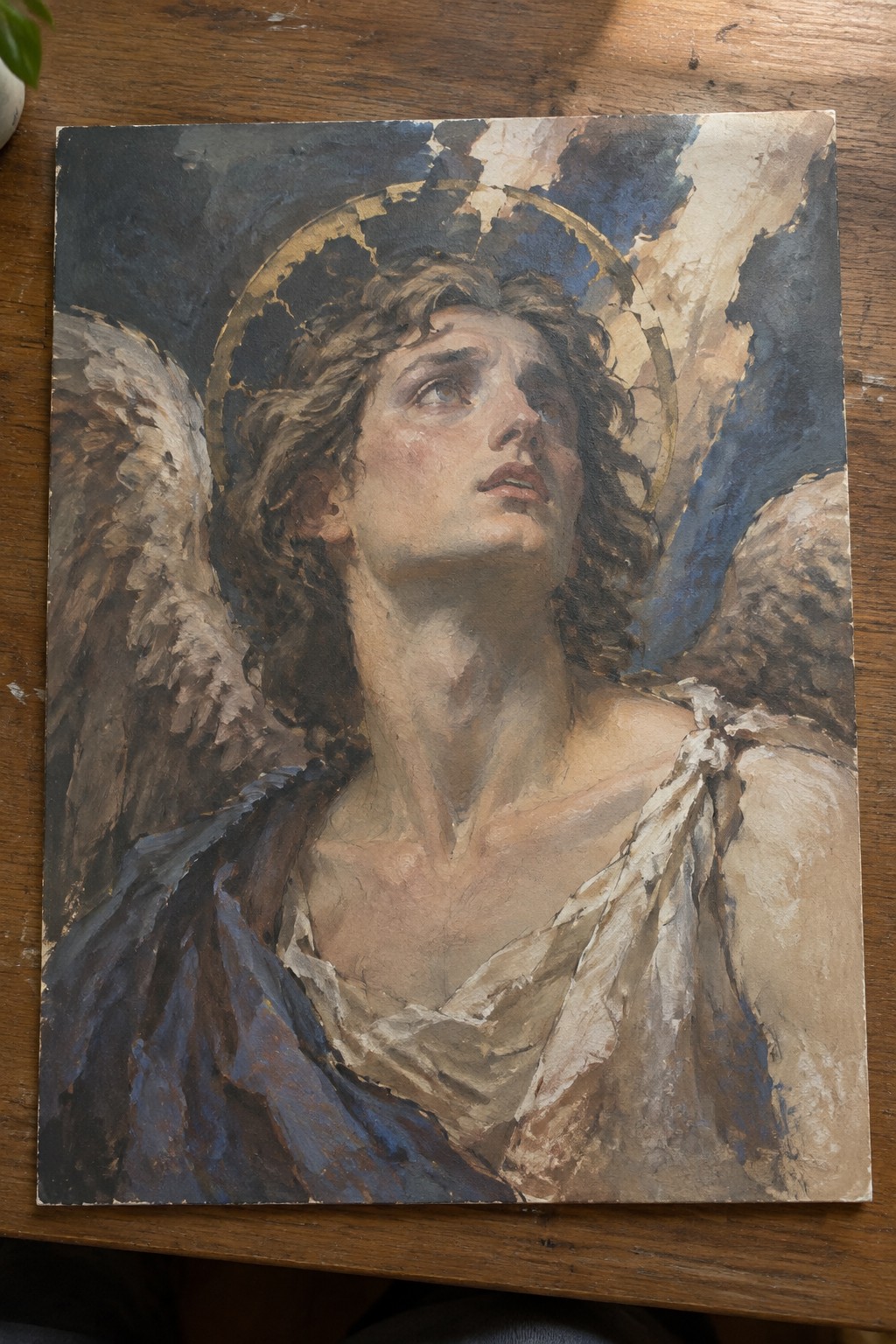
A fallen angel painting idea works through a tight portrait framing that puts the focus on the head, shoulders, and wings while using a low angle to create height and tension. The halo sits slightly off-center with visible cracks and flaking, which adds texture without extra detail work. Muted earth tones and deep blues keep the palette simple, letting the brushwork on the feathers and fabric do the visual heavy lifting.
What makes this idea useful is how the upward tilt and partial wings deliver drama without requiring a full figure or complex background. The composition stays manageable for practice because it limits the main elements to the face, neck, and shoulder area. You can easily adapt the halo treatment or swap the fabric folds for different textures while keeping the same angle and lighting. For wall pieces, the vertical emphasis and limited color range make it straightforward to scale up or tone down depending on the space.
Frequently Asked Questions
What makes fallen angel paintings from the Renaissance period particularly dramatic compared to other eras?
Renaissance artists emphasized intense emotional expressions, dynamic poses, and strong contrasts between light and dark to convey the turmoil of the fall from grace. These elements create a sense of movement and depth that draws viewers into the scene, often highlighting the angels’ inner conflict through realistic human features and architectural settings inspired by classical antiquity.
Which famous Renaissance artists are known for depicting fallen angels in their works?
Artists such as Sandro Botticelli and Luca Signorelli created notable examples that feature fallen angels in biblical scenes like the Last Judgment. Their contributions stand out for blending religious themes with innovative techniques in perspective and anatomy, making the figures appear lifelike and emotionally charged while reflecting the era’s humanist interests.
Where can viewers find or view the original 21 dramatic fallen angel paintings today?
Many of these works are housed in major European museums including the Uffizi Gallery in Florence and the Vatican Museums in Rome. Digital archives from institutions like the British Museum also offer high-resolution images and virtual tours, allowing enthusiasts to study details such as brushwork and symbolism from anywhere without needing to travel.
What common symbols appear in Renaissance depictions of fallen angels?
Symbols often include broken wings to represent loss of divine favor, chains or fiery backgrounds to signify punishment, and expressions of despair that echo human suffering. These motifs draw from biblical texts and classical mythology, helping viewers interpret the moral and spiritual lessons embedded in the compositions.
How does the Renaissance style influence modern interpretations of fallen angel art?
The Renaissance focus on realism, balanced composition, and emotional depth continues to inspire contemporary artists and illustrators who adapt these techniques for new media. Studying these historical examples can guide viewers in recognizing how light, color, and form convey narrative tension, enriching appreciation for both original pieces and their modern echoes.